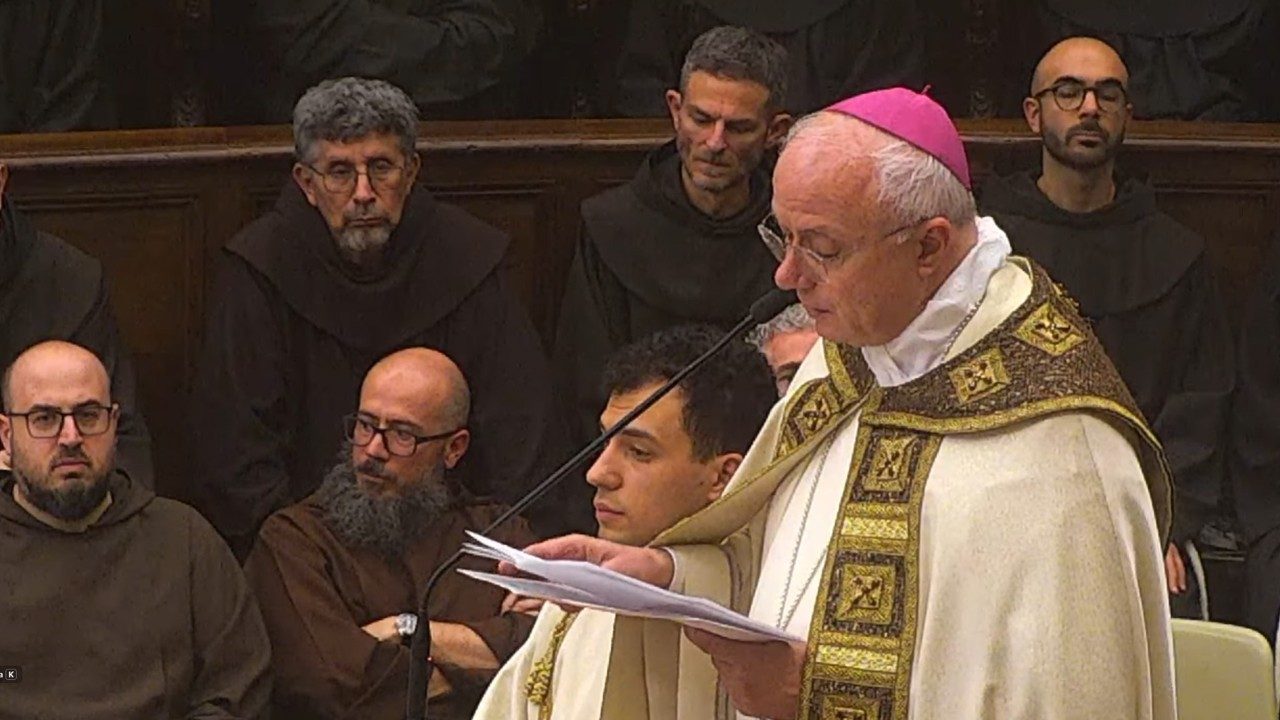
The secretary general of the Italian Bishops’ Conference (CEI), Monsignor Giuseppe Baturi, presided over the celebration of First Vespers for the 800th anniversary of the death of St. Francis. The ceremony took place on Saturday, October 3, 2026, at the Basilica of Santa Maria degli Angeli in Assisi, commemorating the Transitus of the Poverello, which occurred on October 3, 1226, just a few steps from the Portiuncula. Before a basilica filled with faithful and religious from around the world, the archbishop of Cagliari delivered a homily in which he drew a parallel between the «secret» of the death of Italy’s patron saint and the cultural drift of our time.
Confirmed details of the celebration
The celebration of First Vespers was attended by Cardinal Ángel Fernández Artime, Pontifical Legate for the Basilicas of Assisi; the bishops of the Permanent Episcopal Council of the CEI; Monsignor Felice Accrocca, bishop of the dioceses of Assisi-Nocera Umbra-Gualdo Tadino and Foligno; the Ministers General and Provincial of the Franciscan Families; and pilgrims. After the celebration, the offering of gifts took place, presented by the mayor of Assisi, Valter Stoppini, and the institutional authorities present. Finally, Friar Massimo Fusarelli, minister general of the Order of Friars Minor, offered a greeting.
The Christian gaze before death
In his homily, Monsignor Baturi said: «We live in a culture that eliminates death, hides it, or else anticipates it and manages it as a problem to be solved.» In response, the Poverello of Assisi points the Church in the opposite direction: «To look in the face what frightens us and call it ‘sister,’ without denying it and without fleeing from it.» The prelate stressed that this gaze requires not being alone: «Sister death is not welcomed with the strength of the individual, but within a relationship, the relationship with the Crucified One, who passed through the darkness first.» Therefore, the Church must offer a presence: «to stand beside those who suffer, without looking away and without being in a hurry to close the matter.»
Proximity, guardianship and care
Monsignor Baturi’s words contain a concrete pastoral challenge for parishes, families and healthcare structures, articulated along three axes: proximity, guardianship and care. «This concerns all of us, from parish communities to families, from hospices to those who care at home for an elderly father or mother. No one should die alone and no one should be left alone to bear the weight of one who is dying,» he warned. He also recalled that Francis, even in his agony, did not isolate himself, but showed that «the dying person is not only the one who receives care, but the one who continues to care.» Hence the invitation to pause before exhausted families, inhabiting the space of suffering «with competence and tenderness, because it is the space in which fraternity becomes concrete.»
Context and relevance
Monsignor Baturi described St. Francis’s final moments as an affirmation of love for life: «He dies singing… And he sings the beauty of life! This song is also a lesson in guardianship.» He added that «whoever sings knows that life is a gift and that a gift is guarded from its beginning to its last breath.» In a world that measures everything by usefulness, «Francis’s praise is a radical prophecy: it says that no life is without value, not even one that is fading.» The prelate linked this vision to the current geopolitical context: «To those living in a time of polarizations, fear of the other and wars, the Church does not offer abstract consolation, but the certainty that no one is an enemy because the same embrace is destined for all.» And he clarified: «To proclaim paradise today does not mean escaping from history, but inhabiting it with a hope that makes it more human.» Finally, quoting the Poverello’s last words to his brothers («I have done my duty; may Christ teach you what is yours!»), he reaffirmed that Francis did not leave a program, but an example to imitate. The Church’s mission, he said, is to repair it every day: «to transform fear into covenant and to recognize a brother and a sister in the one who dies, in the one who is discarded.»
Original source: www.vaticannews.va (published October 3, 2026)