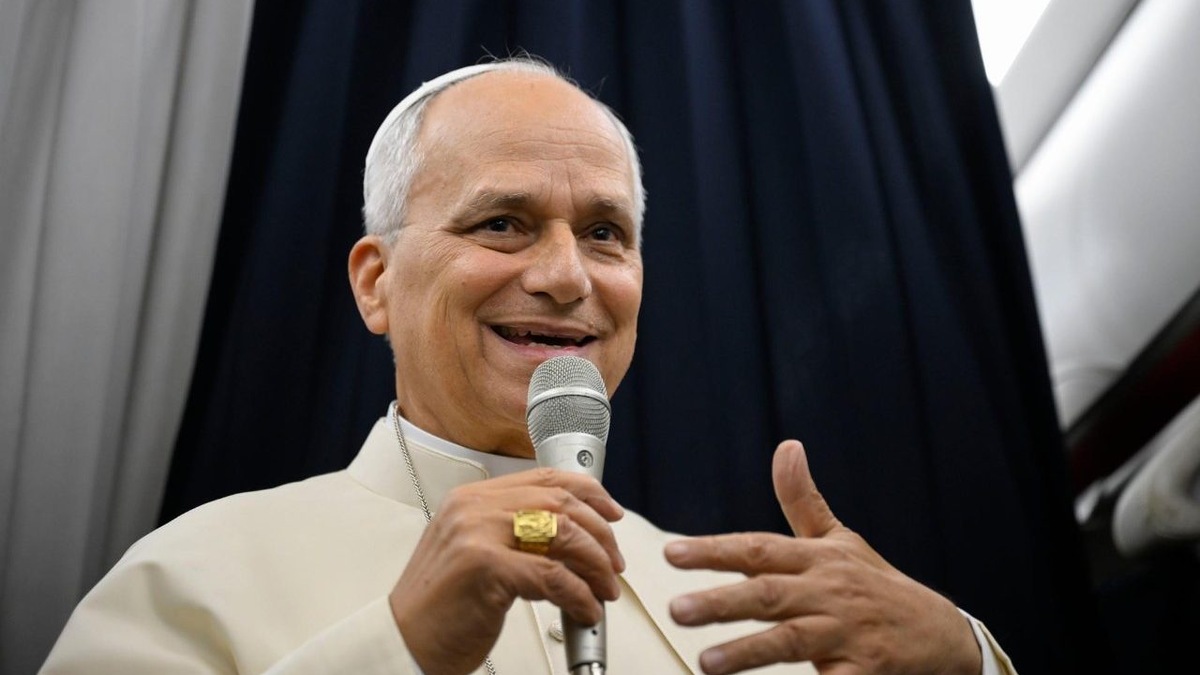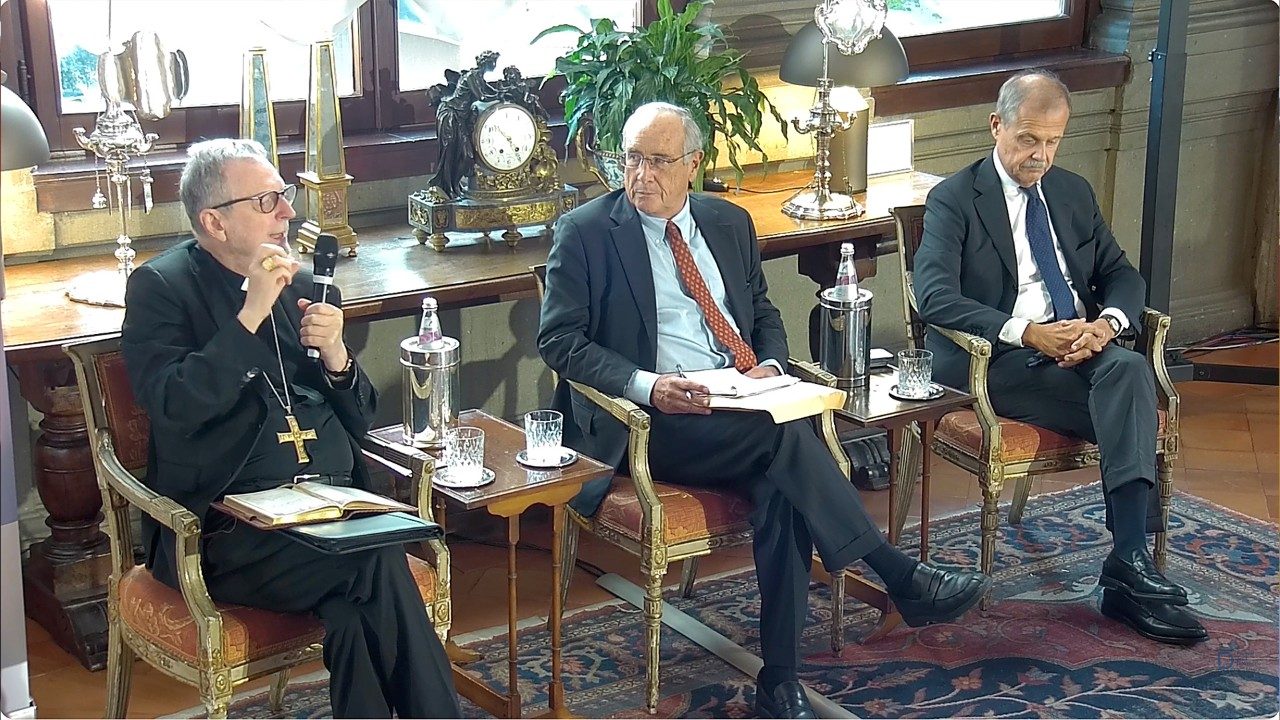
Cardinal Claudio Gugerotti, prefect of the Dicastery for the Eastern Churches, said that «if we want to understand anything about this world, we must put the religious question back at the center.» He spoke during a discussion with Ambassador Giampiero Massolo, moderated by journalist Massimo Franco, held at the Italian Embassy to the Holy See as part of the 17th edition of the Festival of Diplomacy.
Gugerotti stressed that the problem is also cultural: «The horizon not only of analyses but even of textbooks has now shrunk to the last thirty years: we no longer study history. And so we do not give the religious factor the importance it deserves.» According to the cardinal, the religious question «continues to represent a fundamental component of global identity and, above all, of certain peoples.» As examples, he cited the tensions in the Holy Land, where the three great monotheistic religions coexist with difficulty, and the history of the countries of the former Soviet Union, where not even decades of state atheism managed to erase the ecclesial fabric and religious experience.
The prefect also referred to the style of papal diplomacy, characterized «above all by discreet, silent gestures and interventions far from the spotlight.» He recalled the phone calls of the Pontiffs to heads of state, whose «main goal is to convey a message to populations so they understand they are not alone.» According to Gugerotti, the risk of overlooking these aspects is not so much atheism as indifference toward a dimension that has deeply influenced and continues to influence the world order.
Ambassador Massolo raised a different question: «We must ask to what extent the religious factor, undoubtedly important, is nevertheless incorporated into the synthesis process that governments carry out to make political decisions.» He added that «when choosing, states tend to put the principle of security ahead of any other.» Massolo linked this logic to Russia’s decision to invade Ukraine, to Europe’s determination to prevent a decisive victory by Moscow, and to US President Donald Trump’s «America First» slogan.
The debate widened to international disorder. Massolo described a system structured on two levels. At the forefront he placed the United States and China, together with a Russia that, although it does not have the same economic strength as the two superpowers, retains the decisive weight of its nuclear arsenal. According to Massolo, «these are three powers that do not want to confront each other but, on the contrary, are interested in preserving a certain strategic compatibility, preventing local crises from escalating into a global confrontation. The key word is compatibility with economic advantages.» He mentioned that the term «constructive strategic stability» emerged from the latest meeting between Donald Trump and Chinese President Xi Jinping.
At the lower levels, Massolo continued, «conflicts multiply, chaos reigns: wars do not end, fighting continues without reaching peace. At most there is an armistice, a balance is reached: nothing more.» At this point, he argued that a structure like Europe’s is creaking: «The EU has built much of its influence on the ability to draft and export norms, but today those same norms are applied selectively. Europe’s normative power thus risks becoming an element of weakness. And variable geometry seems one of the few viable paths, without however offering a reassuring horizon.»
Context and relevance
The meeting, held as part of the Festival of Diplomacy, addressed the relationship between the religious question and governments’ priorities based on security and national interests. The debate’s closing questions—how to interpret wars by reconciling the religious dimension with those priorities, and what room remains for diplomacy in a system where norms seem to be losing importance—were left as open questions. Gugerotti’s remarks insisted that indifference toward religion, rather than atheism, is the main risk for understanding the world order, while Massolo offered the perspective of states and their inclination to prioritize security.
Original source: www.vaticannews.va (published October 22, 2026)