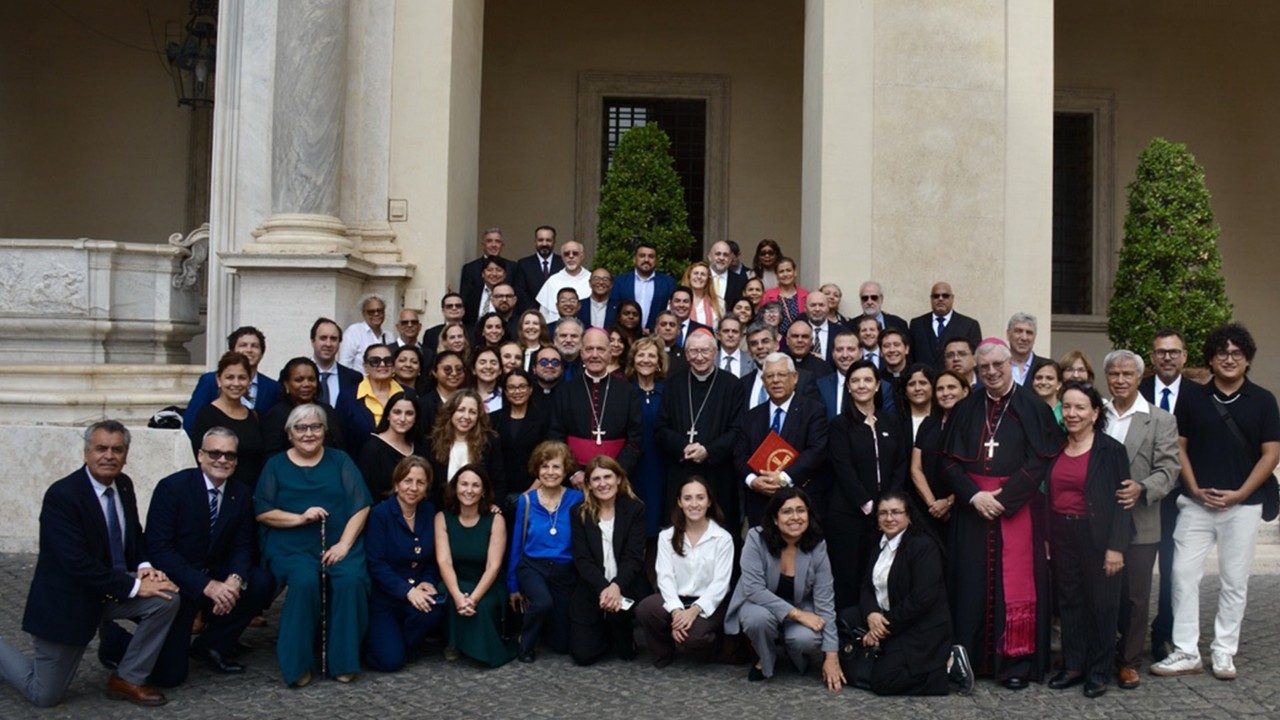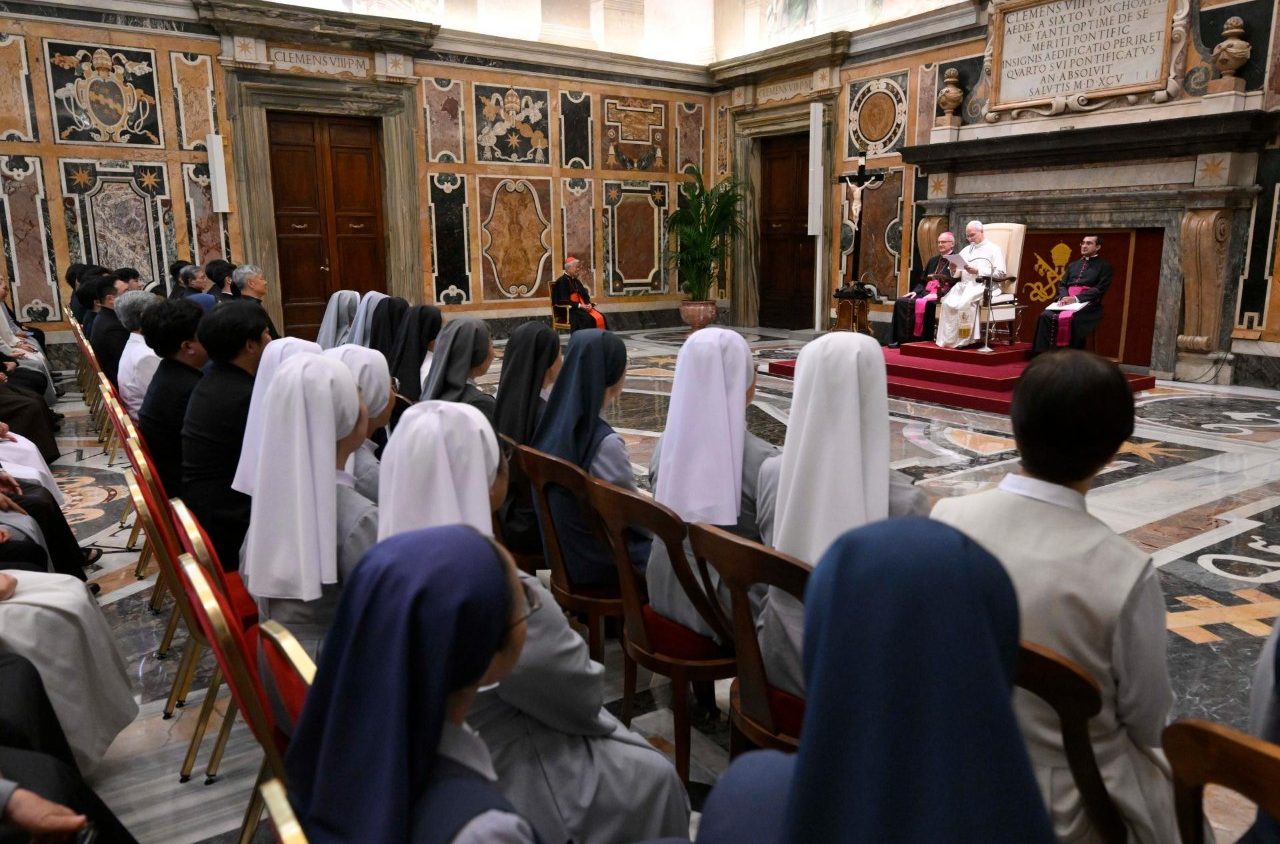
Pope Leo XIV received on Monday at the Vatican Korean priests, religious sisters and brothers residing in Rome, to whom he addressed a message focused on the memory of the martyrs, hope and reconciliation. During the meeting, the Pontiff emphasized that the Church in Korea has grown thanks to the witness of the martyrs and urged them to be “custodians of memory, witnesses of hope and artisans of peace.” He also invited them to continue preparing “with passion” the World Youth Day in Seoul 2027.
The Pope began his speech by recalling the place where he was: “Here, in the place where the memory of the apostles Peter and Paul is preserved, the faith they received in Korea finds its roots and can receive a new missionary impulse. You come from afar, it is true, but here you are at home.” At the audience, he greeted in a special way those working in the preparation of WYD Seoul 2027 and commemorated the twenty-fifth anniversary of the inauguration of the headquarters of the Pontifical Korean College, expressing his gratitude for the service rendered to the Church in Korea and to the universal Church.
Leo XIV underscored the uniqueness of the history of the Korean Church, noting that the faith germinated “spontaneously” and developed “through the sincere search for truth by men who came to know Christian texts and wanted to know more about Jesus Christ.” From that search arose the desire for Baptism and, from there, a community that recalled the Church of the origins. The Pontiff summarized this history in two words: memory and hope. He explained that Christian memory “is not nostalgia, but gratitude for what God has done and responsibility for what He entrusts to us today,” while hope “is not mere optimism, but the certainty that Christ has risen and that no darkness can have the last word.”
The Pope emphasized that “the Church in Korea has grown thanks to the witness of the martyrs” and praised the strength of the Korean people, who “have gone through persecutions, wars, poverty and divisions, knowing how to rise and look forward.” Illuminated by the Gospel, that tenacity has become Christian fortitude, “the ability to go through trials without losing hope and without allowing suffering to harden the heart.” In this context, he recalled the Venerable Thomas Choe Yang-Eop, the second priest in the history of Korea, known as the “martyr of sweat,” who for eleven years tirelessly traveled the roads of the country “to reach distant and hidden Christian communities, bringing them the Word of God and the Sacraments, until he consumed his life in service.”
“To guard the memory of the martyrs means allowing their faith to remain alive in our decisions, in service, in forgiveness and in the giving of ourselves,” the Pontiff stated. He noted that there is the martyrdom of those who offer their life in an instant and that, more hidden, of those who give it day after day, and stressed that all Christians are called to “give their life with love, every day.” He added that “our time needs precisely this: men and women who have the courage to do good even when it costs them.”
In this sense, he urged them to become neighbors to “those who are alone,” to support “those who are tired” and to seek out “those who have drifted away,” having “the courage to forgive, to start again and to dialogue.” He recalled that “good is not always recognized and often requires effort, but it is this daily courage of charity that makes our proclamation of the Gospel credible.” The strength to live this way, he said, comes from friendship with Jesus Christ, who told his disciples: “I have called you friends.” He invited them to care for that friendship by nourishing it in the Eucharist, in listening to the Word, in prayer and in silence before the Lord, for “it is by being with Him that we rediscover the joy of our vocation and learn to love as He does.”
The Pope also referred to fraternity and synodality, inviting those present, who come from different dioceses, institutes, congregations and experiences, to make that diversity a resource for synodality. “A synodal Church is a Church that walks united behind the same Lord, listening, welcoming and recognizing in the other a brother and a companion on the journey, never a competitor,” he stressed.
Context and relevance
When thinking of the Korean peninsula, which “still bears the painful wound of division,” Leo XIV asked priests and religious to be “always men and women of reconciliation.” He explained that “peace begins in the heart and in daily relationships, when we listen instead of judging, forgive instead of holding grudges, choose communion instead of confrontation.” He invited them to remain united and to be “artisans of peace,” and to continue striving and praying “so that new paths of encounter may open and so that the Gospel of peace may be proclaimed freely in every corner of the Korean peninsula and of the world.”
The Pontiff recalled that “Korea, which was once a mission land, has today become a homeland of missionaries,” and emphasized that the upcoming World Youth Day will make this visible, since young people from all over the world will arrive in “a land where the Gospel has grown thanks to the witness of the martyrs.” “I would like it to be a great encounter between memory and the future: the martyrs hand on the faith to the new generations and the young receive it to carry it along the paths of the world,” he expressed. He asked them to listen to young people, walk with them and help them discover that “following Christ does not limit freedom, but fulfills it” and that “faith does not restrict life, but opens a broader horizon for it.”
The Pope concluded by inviting them to continue preparing WYD “with passion” and, in this month dedicated to the Holy Rosary, entrusted to the Immaculate Virgin Mary, Patroness of Korea, together with the journey toward World Youth Day, asking Saint Andrew Kim Tae-gon, Saint Paul Chong Ha-sang and all the Korean holy martyrs and blessed martyrs to accompany them and make them “custodians of memory, witnesses of hope and artisans of peace.”
Original source: www.vaticannews.va (published on October 5, 2026)