Bishop Walter Guillén Soto, of the diocese of Gracias, in Honduras, has officially recognized a new Eucharistic miracle that occurred in 2022 in the small rural parish of El Espinal, a community of about 60 families scattered in the hills near the city of San Juan. There is no permanent priest in this place, so liturgical celebrations are led by an extraordinary minister of Holy Communion.
The Discovery in the Tabernacle
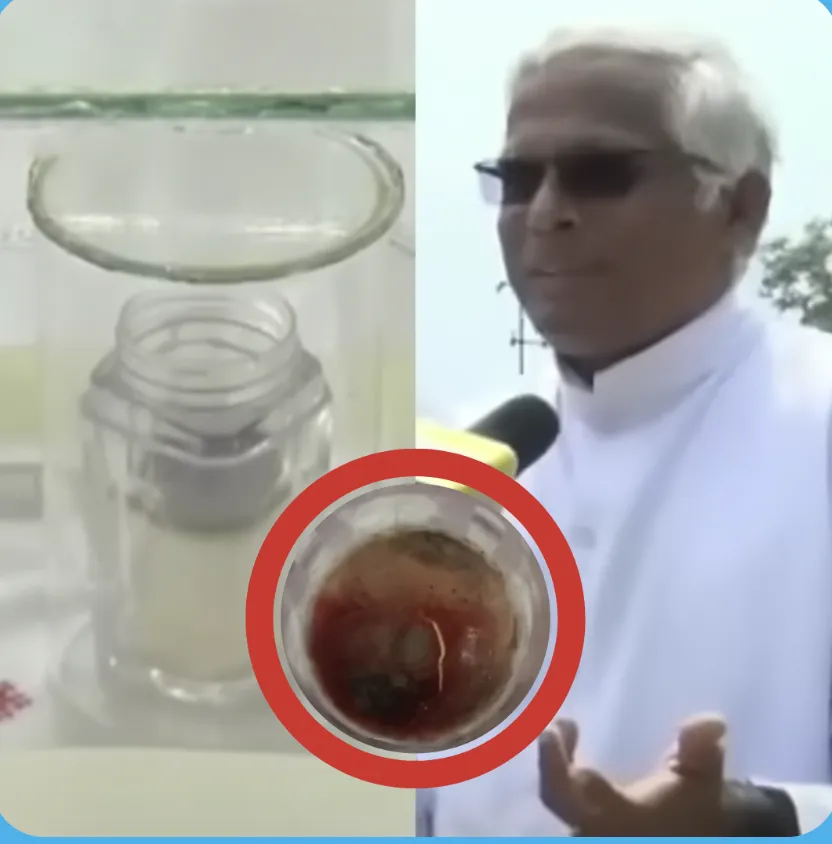
On Thursday, June 9, 2022, during the 5 p.m. Mass, the minister José Elmer Benítez Machado, who was officiating the Liturgy of the Word and the rite of Communion, opened the tabernacle and discovered stains that looked like blood on the corporal that wrapped the wooden ciborium with the Blessed Sacrament. According to his account to local media, upon seeing it he felt great joy and thought: «This is the Blood of Christ.» Although he was moved, he managed to contain his feelings and concluded the ceremony.
After finishing, he asked those present if anyone had noticed a leak in the chapel roof, since he initially thought it might be a water stain. Everyone denied it, and the assembly became convinced they were facing an extraordinary event. The missionaries of the Sacred Heart, who had recently served in the village, arrived from San Juan, collected the corporal, and placed it in a sealed container to deliver it to the bishop.
Investigation and Scientific Tests
Bishop Guillén Soto, known for his prudence, did not accept the fact immediately. «I am not inclined to naive belief; logic makes us prudent,» he stated to EWTN News. Therefore, in late October 2022, the material was subjected to forensic and toxicological analyses. Experts ruled out that the stains were wood resin, animal blood, pigment, or any other substance. Additionally, the corporal showed no fungi, mold, or contamination, despite the time that had passed.
The results confirmed that it was human blood, with blood type AB+, the same that has been identified in other recognized Eucharistic miracles, such as those of Lanciano and the Shroud of Turin. Given this evidence, the bishop acknowledged that the phenomenon was humanly inexplicable and described it as «an extraordinary, visible, tangible, and verifiable sign» of the Lord’s presence.
A Call to the Laity
The prelate emphasized the uniqueness of this miracle manifesting in a rural community and through a layperson, not a cleric. He called it «the miracle of conciliarity» and stated that «it is the time of the laity.» In his words, «the faith of the laity has kept the Church alive in these regions,» and he added that for him and his clergy it was «a call to conversion.» Father Sotelo, consulted on the matter, agreed that each person will interpret the event in their own way, but ultimately it is an invitation to conversion.
All the material has been sent to the Vatican for final verification. This recognition adds to other documented cases of Eucharistic miracles and reinforces the devotion of the faithful in an area where priestly presence is scarce.
Original source: medjugorje-news.com (published on August 15, 2026)
Photo: Héctor Emilio Gonzalez on Unsplash