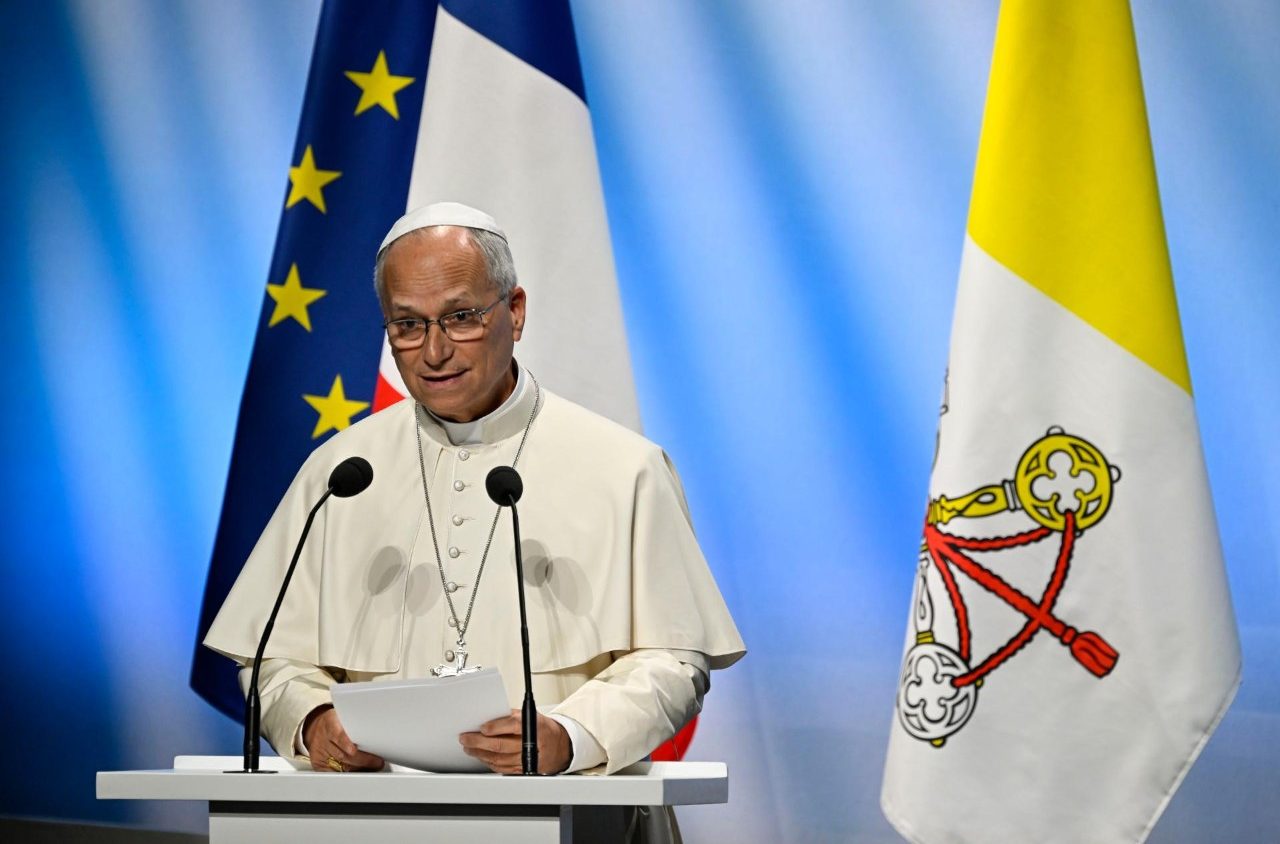
Pope Leo XIV presided in Metz, northern France, over the event titled «At the Roots of Europe for Peace and Unity,» at the Robert Schuman Congress Center. In his speech, delivered in French, the Pontiff stated that «today, human relations and relations between states are becoming increasingly barbaric.» The city, a crossroads between French and German culture, was the setting for a message focused on peace and European unity.
Confirmed Details of the Event
The event was attended by all French bishops, the presidents of some Episcopal Conferences, Prince Albert of Monaco with his wife Charlene, and other representatives of institutions. The Pope was accompanied by President Emmanuel Macron and Cardinal Jean-Marc Aveline, both seated on the platform next to the Pontiff. The Choir and Orchestra of the Metz Opera performed pieces of solemn drama. The Pope was received with more than a minute of applause.
The Central Message: Peace and Rearmament
Leo XIV based his speech on the Schuman Declaration of May 9, 1950, which, he said, has contributed «to forging the Europe of today and tomorrow.» The text served as a common thread for reflections interwoven with thoughts from Alcide De Gasperi, St. Paul VI, Pope Francis, and St. Benedict, another «father of Europe.» The Pope recalled the roots but looked to the future and, with apprehension, to the present marked by migration, misery, lack of respect for human dignity, and conflicts that stifle all «desire for peace.»
«The pursuit of peace in Europe, as in the rest of the world, must not be confused with a naive irenism,» the Pope clarified. Quoting Schuman, he stated that «world peace cannot be safeguarded without creative efforts proportionate to the dangers threatening it.» However, he warned against the illusion of rearmament, noting that repeated calls to increase military spending and the resulting decisions are presented by many leaders with the justification of others’ dangerousness.
Creative Efforts and International Law
«Fostering peace is an active task,» said Leo XIV, and he raised a crucial question: «Today we must ask whether we are truly making ‘creative efforts’ to promote world peace, or whether we are simply trying to ‘stem the hemorrhage of war’ and better prepare for those we suppose are yet to come.» He recalled Schuman’s vision of a Europe that «prefers dialogue to confronting with weapons,» where «resources are pooled to make any war not only unthinkable but materially impossible.»
The Pope stressed that international law and multilateralism constitute «the best antidote against the will to dominate, which is at the origin of all conflict.» He observed with bitterness how the value of the given word is belittled and, conversely, lying and deception are boasted of. Europe, he said, can put an end to this spiral thanks to the respect for others that it has managed to cultivate and preserve, since it has demonstrated over the past eighty years that it is possible to assert divergent opinions, claims, and interests by meeting rather than confronting each other.
Dignity of Migrants and Dialogue Between Cultures
Leo XIV called for «realism and courage,» as well as «confidence» in the ability to move forward to take «small steps» that can give rise to a «concrete solidarity» ensuring that «no one feels abandoned or forgotten.» He recalled the values on which civil coexistence is founded: the «inviolable and inalienable rights of the person, freedom, democracy, equality, and the rule of law.» These values are wavering, he said, also in the face of the «arrival on the continent of so many men and women fleeing war and persecution, or seeking a better life far from poverty and misery.»
To the entire EU, the Pope reiterated the appeal already expressed in the Canary Islands: human dignity demands legal and safe pathways, rescue and assistance, real cooperation against traffickers, effective protection of victims, serious processes of reception and integration, and policies that allow each person to live with dignity in their own land. «To welcome a person means to integrate them as into one’s own family, offering them the possibility to develop their talents, abilities, and sensitivity, but also to enter into the spirit of the home that welcomes them,» he added.
This dialogue «is possible,» the Pope guaranteed, thanks to «the universality of Europe’s founding values.» Moreover, this dialogue of «historic scope» allows «acting more effectively in favor of peace and a reconciled world.» Leo XIV exhorted to have the same «lucidity» with which Schuman knew how to «overcome the opposition between cultural identities» and «bring European institutions to life, at the end of the terrible tragedy of World War II, which revealed how great is the evil that man commits when he believes he encounters no obstacles in the exercise of his power.»
Context and Relevance
Robert Schuman, who lived in an era of constantly evolving borders, helped lay the foundations of a Europe aware of the urgency of tearing down the walls that divided it. His Christian formation conveyed to him the value of equality, without distinction of race or social class, and taught him the dignity of work. This vision is what Pope Leo XIV sought to instill in young people in the final part of his speech, with a call to «build the Europe of today and tomorrow.»
Addressing them, the Pontiff asked: «Have the courage to live responsibly the mission of building peace, in your heart, in your relationships, in your family, in schools and universities, in the life of your cities, your countries, and all of Europe.» And he added: «Do not submit to the logic of violence and oppression. Love life at every moment and do not be afraid of the future! Do not be afraid to form a family, to have children, to defend the dignity of every person, from the first instant in the mother’s womb to the last breath. Do not be afraid to work tirelessly in the service of the good of your communities, even through political commitment.» Finally, he exhorted: «Be builders of community! And with you, Europe, firmly rooted, will continue to flourish and inspire the whole world.»
Original source: www.vaticannews.va (published on September 28, 2026)