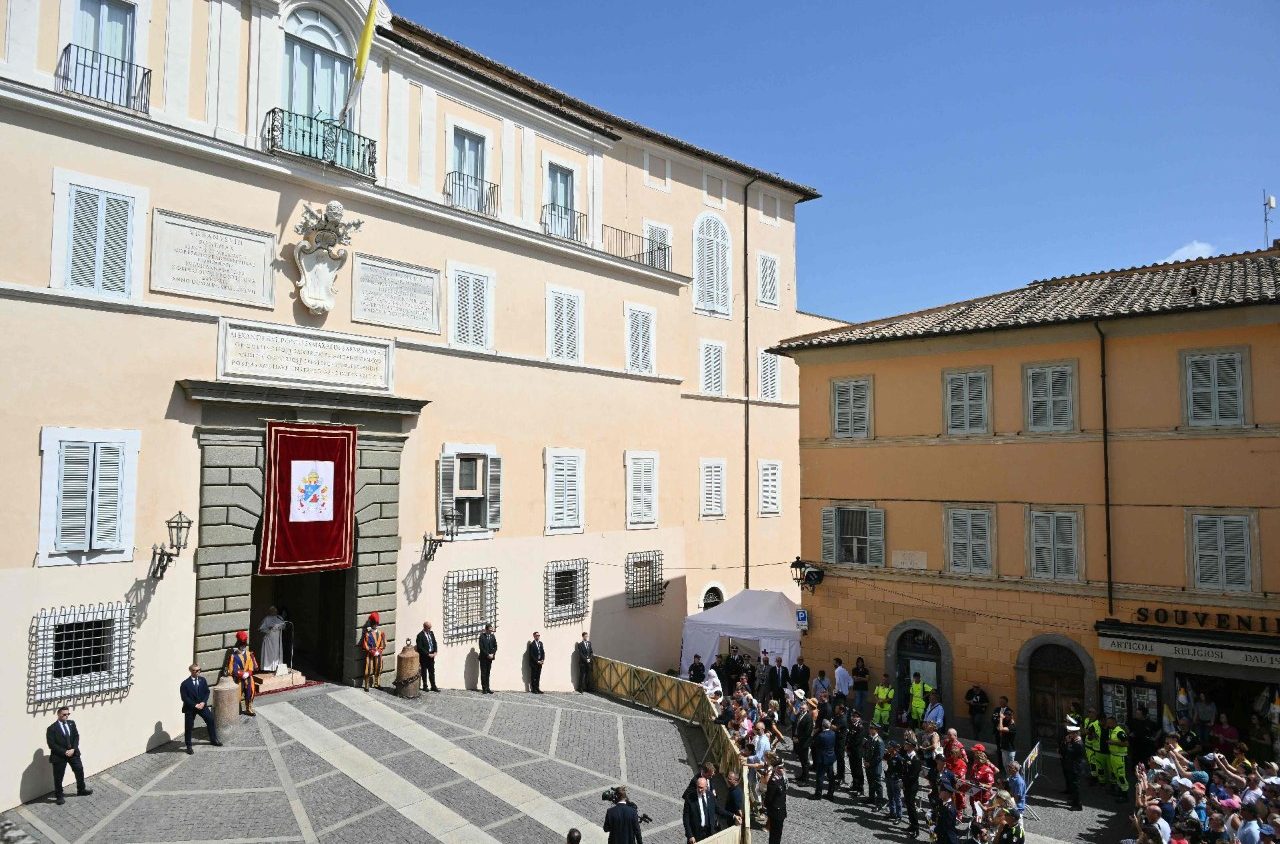
This August 30, Pope Leo XIV presided over the Marian prayer of the Angelus from the Pontifical Villa in Castel Gandolfo. Before thousands of faithful and pilgrims gathered in Liberty Square, the Holy Father commented on the Gospel of the Twenty-Second Sunday in Ordinary Time, focusing his reflection on the figure of the apostle Peter and on two fundamental attitudes for the life of faith: sincerity and docility.
In his address, the Pontiff noted that the biblical passage of the day presents Jesus revealing to his disciples the mystery of his imminent Passover. According to the Gospel text, the Messiah «had to go to Jerusalem and suffer greatly there at the hands of the elders, chief priests, and scribes, and be killed and on the third day be raised.» This statement, the Pope explained, contrasted with the expectations of a triumphant and powerful Messiah that many were hoping for.
Pope Leo recalled that Peter, who shortly before had recognized Jesus as «the Messiah, the Son of the living God,» reacted with surprise and disappointment to the announcement of suffering. The apostle even rebuked the Master with the words: «God forbid, Lord! This shall never happen to you.» The Holy Father described this gesture as «an impulse of fervor, undoubtedly motivated by sincere love that, nevertheless, makes us reflect.»
The Pontiff stressed that even for today’s Christians it is not always easy to understand and accept God’s ways, especially when they diverge from one’s own plans. In those moments, he warned, temptations arise that go «against all logic of faith,» such as thinking that the Lord is mistaken, that he does not listen, or that he is not concerned about us.
Faced with this reality, the Pope highlighted two teachings that Peter offers even in his impulsiveness. The first is «never to interrupt, even in these moments, the dialogue with the Lord; rather, to manifest to him with confidence our difficulty in understanding what he asks of us.» The second is «never to judge God’s ways, but rather to listen humbly in prayer to what he is revealing to us through his action, even when it does not correspond to our expectations.»
Context and relevance
The Holy Father also dwelt on Jesus’ response to Peter: «Get behind me, Satan!» He explained that, despite the harshness of the correction, the apostle accepted the challenge and remained faithful to Christ’s words until martyrdom. This attitude, said the Pope, shows the greatness of the first of the apostles.
Before concluding with the invocation to the Virgin Mary, «who was obedient to God’s designs, standing at the foot of the cross of her son Jesus,» Pope Leo XIV asked the faithful to have the same sincerity as Peter and to cultivate docility. «Let us then ask the Lord that we too may have in our life of faith and in our prayer the same sincerity as Peter, telling him humbly what we truly feel, even when our heart is confused; and, at the same time, that we may know how to cultivate his docility, accepting what he asks of us beyond our expectations.»
Original source: www.vaticannews.va (published on August 30, 2026)