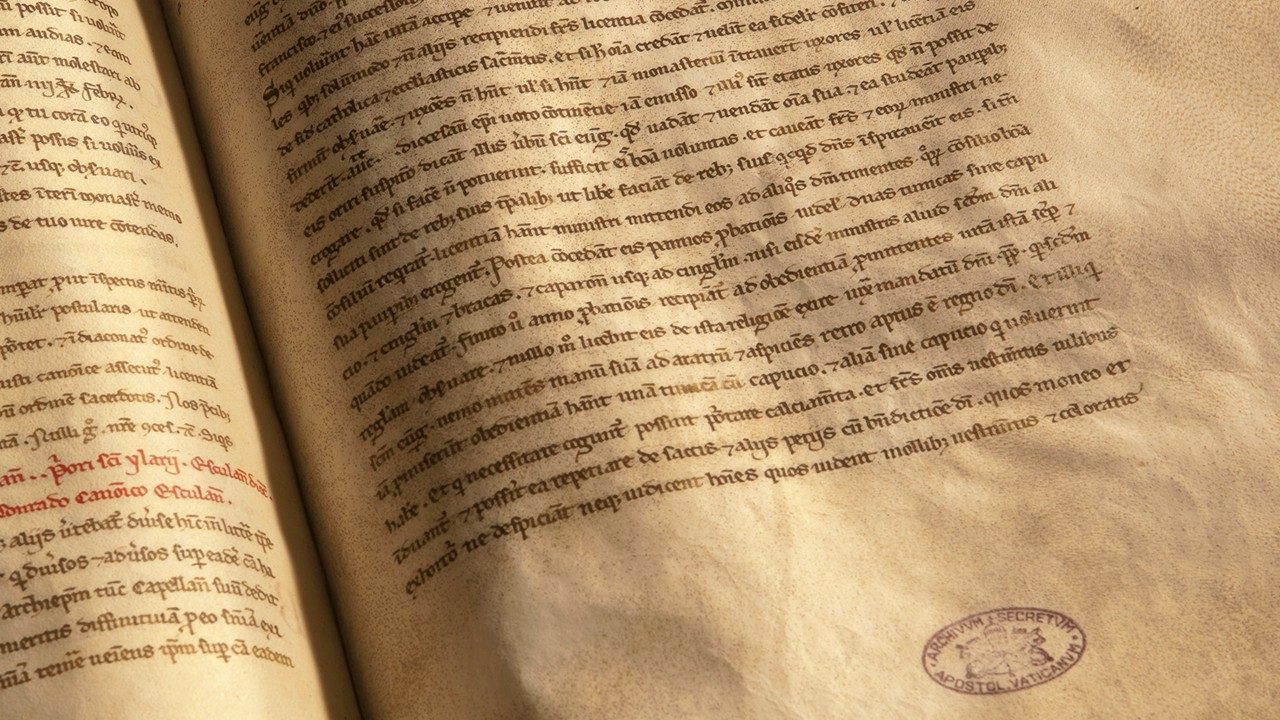
As part of the eighth centenary of the death of St. Francis of Assisi (1226-2026), the Vatican Apostolic Archive is opening the register of Honorius III that contains the 1223 Rule, regarded as the official birth certificate of the Order of Friars Minor. The archivist Enrico Flaiani, professor of General and Applied Archival Science and Conservation of Archival Materials at the Vatican Archives, presents the document and explains its historical significance.
The text, preserved in Vatican Register 12, folios 155r-156v, gathers a selection of Honorius III’s correspondence between 1222 and 1224. The bull Solet annuere, dated at the Lateran on 29 November 1223, is addressed to “fratri Francisco et aliis fratribus de ordine Fratrum Minorum” and confirms the Rule of the Friars Minor. According to Flaiani, it contains the Franciscan Rule as received by the Roman Curia and revised for papal approval. The document sets out in 12 chapters the pillars of the evangelical life conceived by Francis: to live in obedience, without possessions of one’s own and in chastity.
The Sealed Rule is the “second crown” to which Dante refers in Canto XI of Paradise, where St. Thomas Aquinas recounts the life of St. Francis. The first approval was granted verbally by Innocent III, according to St. Bonaventure’s account, after Francis traveled to Rome with a short, simple rule written in 1209 or 1210 and now lost. In 1221 a lengthy text of 23 chapters was drafted, the so-called Rule without a Seal, which did not receive papal approval. Two years later came Honorius III’s definitive confirmation.
Flaiani notes that the 1223 document reflects a community that no longer had much in common with the early brotherhood of Assisi, made up of a small group of residents. The massive influx of clerics had turned it de facto into a religious order. The Rule contained a firm command not to receive money, to obey superiors and to care for religious women and nuns only under certain conditions. At the end of the text, Francis asked, in obedience to the Church of Rome, for a cardinal protector, which for Flaiani shows his interest in institutionalizing the close working relationship with Cardinal Ugolino of Ostia.
After the approval, Francis, increasingly weakened physically by his privations, devoted himself progressively to the life of a hermit. From this period date the episodes of the stigmata and the writing of the Canticle of the Creatures and the Testamentum. When his condition worsened definitively, he was moved to the church of the Portiuncula, where he died on the night of 3-4 October 1226. On 16 July 1228, Gregory IX, the Cardinal Ugolino who had become pope, proclaimed him a saint.
Context and significance
Eight centuries later, Flaiani observes that Francis still fascinates with the same force as in his own time. “All those who have spoken or written about him — Catholics, Protestants, non-Christians, non-believers — have been moved and often captivated by his charm,” he says. He describes him as “a new kind of saint, whose holiness was revealed not through miracles — though numerous — nor through the display of virtues — rare and splendid, however — but through the entirety of an absolutely exemplary life.”
The archivist adds that Francis “has come down to us as a friend and brother of all creatures and of all creation,” and that he showed “such concern, such fraternal understanding toward all, such charity in the highest sense of the word, that is, love,” that history has responded with “an identical sympathy and a widespread, affectionate admiration.” Paradoxically, that simplicity makes him a complex figure: “St. Francis shook the religion, civilization and society of his time. Half religious, half lay, he wove a new practice of poverty, humility and the word, on the margins of the Church but without falling into heresy: a rebel without nihilism.”
For the son of a merchant, the city was the first field of apostolate. He wanted to instill in the city “a sense of poverty in the face of money and the rich, peace instead of the internal struggle he experienced in Assisi, and between Assisi and Perugia.” As a layman, Flaiani continues, “Francis wanted to show that laypeople are worthy and capable of leading, like the clergy, alongside them, a truly apostolic life.”
Francis’s holiness was born in the ordinary world of his time. Born in Assisi between 1181 and 1182, he was baptized by his mother, Giovanna, with the name John the Baptist, in the absence of his father, a cloth merchant who was away on a business trip in France. As a young man he was immersed in the culture of the wealthy merchant class: he devoted himself to poetry, took part in armed clashes between Assisi and Perugia and aspired to become a knight. In 1206 he renounced his inheritance in favor of the bishop of Assisi, Guido, and devoted himself to caring for the sick in the leper hospitals of the countryside and to restoring ruined rural churches.
The friars began to preach in pairs in central Italy, but preaching by unauthorized laypeople carried ecclesiastical penalties for heresy. Hence the journey to Rome and the presentation of the first rule to Innocent III, who gave his assent vivae vocis oraculo, that is, verbally. According to the account of Bonaventure of Bagnoregio, some cardinals considered that way of life strange and too arduous for human strength. Cardinal Giovanni di San Paolo overcame their doubts: “This poor man, in reality, only asks us to approve for him a form of evangelical life. If, therefore, we reject his request as too difficult and strange, let us be careful not to offend the Gospel.” The Pope then turned to Francis: “Pray to Christ, my son, that through you he may show us his will.”
In the following years, Cardinal Ugolino of Ostia proposed to Francis that his friars join an already existing religious order. Francis refused and preferred to leave to preach in Egypt. On his return, the brotherhood had reached a considerable size. The opening of the register of Honorius III in the eighth centenary allows these words to be reread and offers access to the official record of the Rule of the Bullata, transcribed in the volumes of Honorius III’s chancery and preserved in the Vatican Apostolic Archives.
Original source: www.vaticannews.va (published on 26 October 2026)