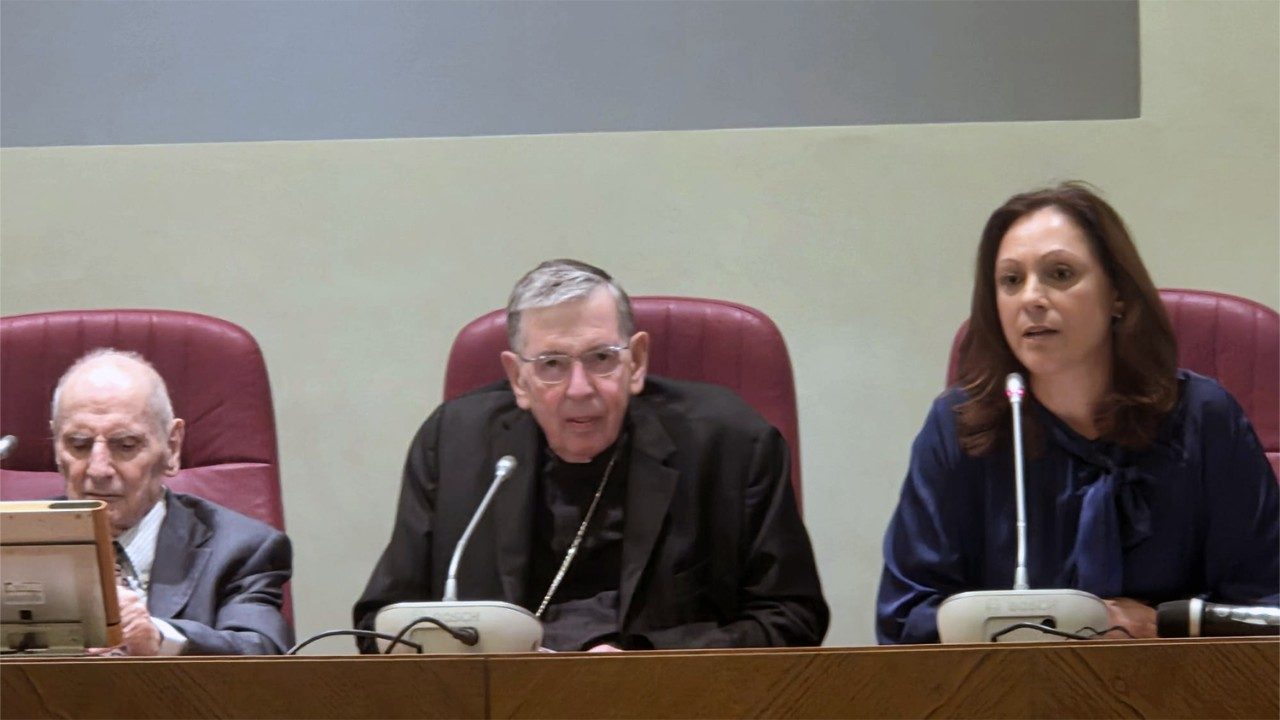
Cardinal Kurt Koch, prefect of the Dicastery for Promoting Christian Unity, stated that peace among the Churches constitutes a responsibility for Europe and that ecumenism can help people live in balance amid multiplicity. He said this in an interview with Vatican News and during his address at the conference “Religions and Diplomacy,” held at the Palazzo San Calisto in Rome from September 28 to 30, on the occasion of the thirtieth anniversary of the International Association “Charity and Politics.”
The conference addressed what religions can contribute to the search for peace and what role diplomacy plays in conflict resolution. The event’s presentation referred to a growing demand for moral reference points in public life, while scientific and technological transformations pose new questions for societies and governments. The opening session was attended by diplomatic representatives to the Holy See and by Maria Angela Falà, former president of the Italian Buddhist Union.
In his address, Koch began with a familiar image of the continent: the European Union, its institutions, the common market, and the euro. He acknowledged that this is a decisive construction, born also from the will to prevent a repetition of the wars that have devastated Europe. However, he maintained that its identity is not limited to economic and political structures. For the cardinal, Europe is also a historical, spiritual, and cultural reality, and from this arose the central question of his presentation: can it preserve a future if it loses awareness of its origins?
Koch highlighted the kinship between the words “culture” and “cult,” to refocus attention on the religious dimension that has helped shape cultures, whereas today culture and cult are often considered alien to each other. To understand European roots, he proposed the image of three hills: Golgotha in Jerusalem, the Acropolis in Athens, and the Capitol in Rome. In them he sees the encounter between biblical heritage, Greek thought, and Roman legal tradition. He took up the words of Benedict XVI, who, in his 2011 speech to the Bundestag, indicated that this encounter is one of the origins of European culture.
In the Greek heritage, Koch recognizes the search for the good and for truth. He observed that a democracy needs a law and a criterion of justice that do not depend solely on the will of the majority. The Christian faith, in encountering Greek philosophy, adopted the rational search for truth as part of its own history. From ancient Rome, by contrast, the prelate highlighted the legal tradition and the capacity to confront Christianity with political power, from which the distinction between Church and State also developed, essential for freedom of conscience.
According to his interpretation, these roots do not refer only to the past. There are three principles that Europe is called to transmit: reference to God, the dignity of the person, and sociability. The human being, he stated, cannot be conceived as an isolated individual, because he realizes his freedom in relationship with others. Koch noted that there is a profound weakening of respect for human life, linked to the loss of awareness of God’s presence in public life. Remembering Christian roots, he specified, does not mean asking for a privileged position for the Church, but recognizing a component of European cultural history and questioning its current vitality.
Context and Relevance
In the interview, when asked what contribution the Churches can make where politics and diplomacy have difficulty finding a way out, Cardinal Koch began with an analysis directed at the Christian world. He noted that one must start from the misunderstandings, differences, and polarizations present today, underlining the need to “also restore peace among all the Churches.” Only from relationships lived in this way, he maintained, can Christians help society seek unity and peace.
The ecumenical path, he added, can offer an experience of coexistence in which multiplicity does not prevent the search for unity. In this sense, Koch evoked the Augustinian motto of Leo XIV, In illo uno unum: a reference for the Catholic Church, for ecumenism, and, from his perspective, also for civil coexistence.
The conference “Religions and Diplomacy” brought together diplomatic representatives to the Holy See and figures from interreligious dialogue, such as Maria Angela Falà. The sessions took place at the Palazzo San Calisto in Rome from September 28 to 30, on the occasion of the thirtieth anniversary of the International Association “Charity and Politics.” The initiative responded to questions about the contribution of religions to peace and the role of diplomacy in conflict resolution, in a context of growing demand for moral reference points in public life.
Original source: www.vaticannews.va (published on September 29, 2026)