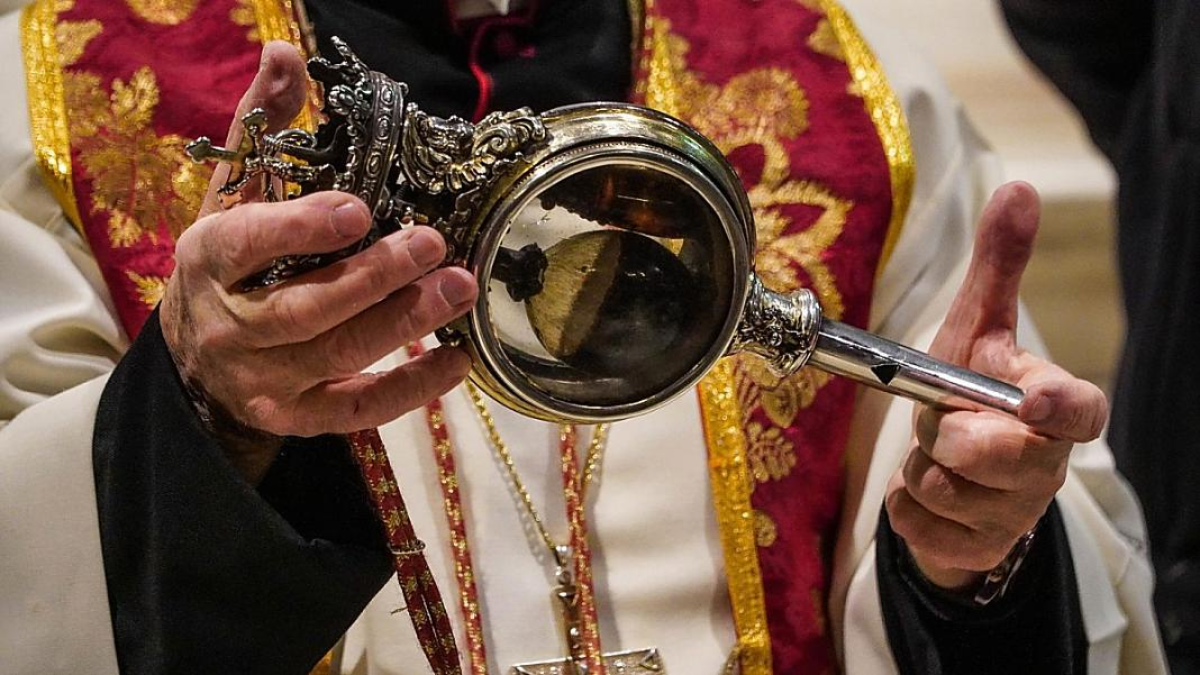
This Tuesday, December 16, the traditional miracle of the liquefaction of the blood of Saint Januarius, patron saint of the city, was repeated in Naples, an event followed with special attention by Neapolitan faithful and deeply rooted in the religious history of the city. According to the Archdiocese of Naples, the prodigy took place after the celebration of Holy Mass in the Royal Chapel of the Treasure of Saint Januarius, within the framework of the Feast of the Patronage, which is commemorated every year on this date.
The process was observed progressively: at 9:13 a.m. (local time), the blood contained in the ampoule was already in a semi-liquid state, and at 10:05 a.m. its complete liquefaction was officially confirmed. The announcement was made by Monsignor Vincenzo De Gregorio, abbot of the Chapel of the Treasure of Saint Januarius, who communicated the event to the gathered faithful. Once the miracle was confirmed, the relic was carried in procession inside the chapel, allowing those present to venerate the ampoule containing the blood of the holy martyr.
A sign deeply linked to the history of the city
December 16 is the third of the three annual dates on which the liquefaction of Saint Januarius’s blood is traditionally expected. This day recalls a decisive episode in the history of Naples: the eruption of Mount Vesuvius in 1631, when the city was threatened by the advance of magma. According to tradition, the Neapolitans then turned to the intercession of their patron saint and attributed to his protection the fact that the lava did not reach the urban core.
In addition to this date, the miracle usually occurs on September 19, the anniversary of Saint Januarius’s martyrdom, and on the Saturday before the first Sunday of May, in commemoration of the transfer of his relics to Naples. These celebrations mark the religious calendar of the city and gather numerous faithful each year.
Sign of protection in Naples
Aciprensa recalls that the liquefaction of Saint Januarius’s blood has historically been interpreted by the population as a sign of protection for the city. When the phenomenon does not occur—as happened on December 16, 2020—many consider it a bad omen. In the face of these interpretations, the Church has repeatedly called for placing these signs within a mature faith, centered on what is essential.
In this regard, on September 19, 2024, although the miracle had occurred, the Archbishop of Naples, Cardinal Domenico Battaglia, reminded the faithful that Christian hope cannot rely solely on extraordinary manifestations. In his exhortation, he emphasized that the blood of Saint Januarius ultimately points to the sacrifice of Christ and to Christian responsibility in the face of human suffering.
Original source: infovaticana.com (published on December 17, 2025)