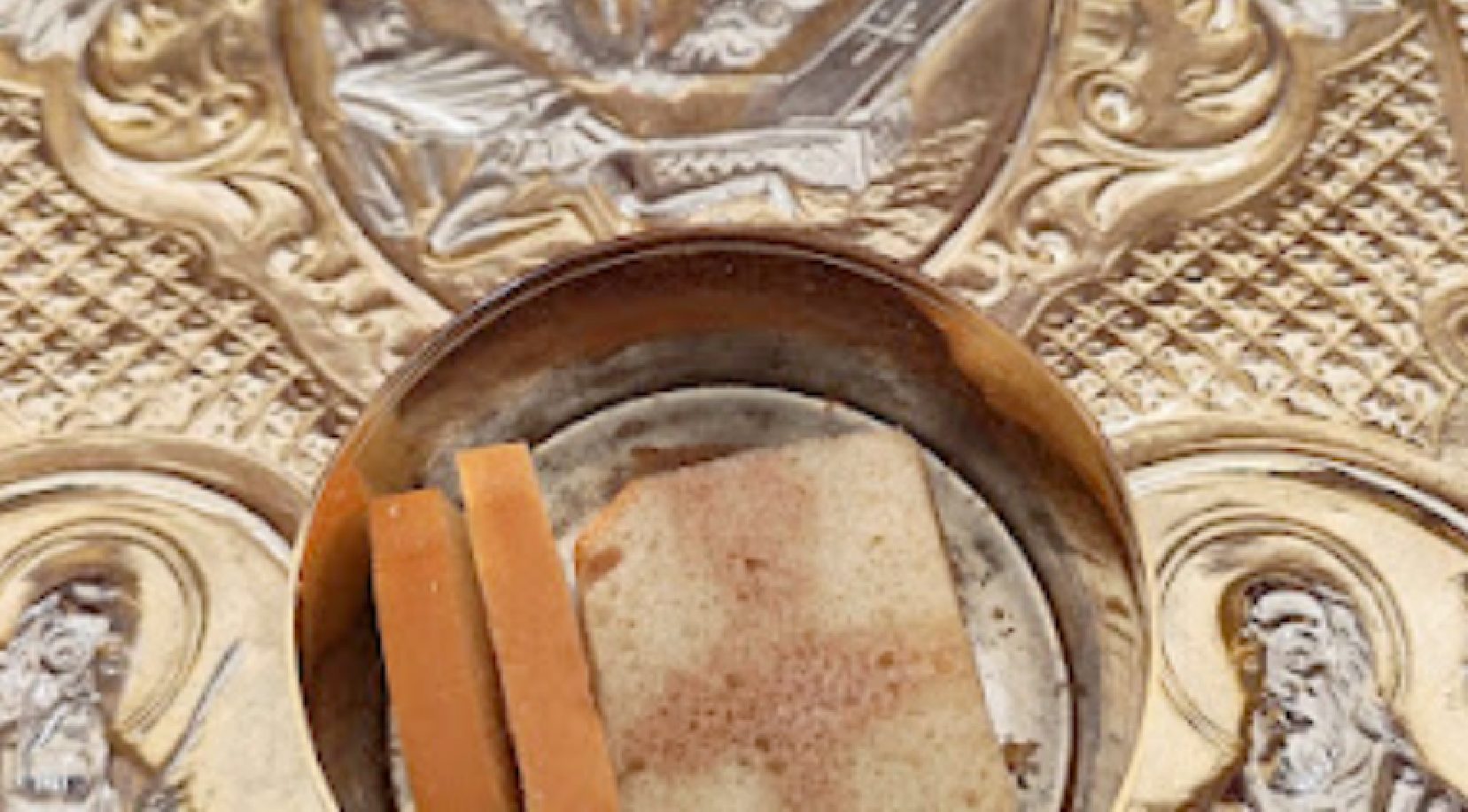
In the town of Tibnine, southern Lebanon, a Melkite Greek Catholic community has experienced a moment of deep consolation amid the devastation caused by the war. In the Church of Saint George, belonging to this parish, the consecrated bread was found completely intact among the rubble, despite there being no signs of human life for several weeks. This discovery, which occurred after the ceasefire of April 17, 2026, has been interpreted by the faithful as a sign of God’s constant presence amid suffering.
Father Marios Khairallah, parish priest of the church, was able to return to the temple after the ceasefire and found the Blessed Sacrament exactly as he had left it before the violence forced the community to flee. Alongside the Eucharist, he also found an intact statue of the Virgin Mary among the ruins, an image he described as “a mother waiting for her children.” For Eastern Catholics, the Eucharist is not celebrated with wafers but with leavened bread, a detail that underscores the uniqueness of the discovery.
The priest expressed his astonishment at the preservation of the consecrated bread: “After 47 days, it is scientifically impossible to explain why the bread did not spoil. But for us this is not strange at all, because we believe it is the Body of Christ. This is our faith, and it is neither new nor unusual. We believe in God’s presence in the Eucharist.” These words reflect the conviction of the community, which sees in this event a confirmation of their faith, rather than a phenomenon requiring scientific explanation.
The situation of the inhabitants of Tibnine remains critical. The town, which is home to about 55 Greek Catholic families, has been left without running water, electricity, or internet access, and the weather is still cold. Families have dispersed among relatives, rented homes, schools, monasteries, or friends’ houses. Humanitarian aid exists but is very limited due to the dangers associated with displacement. In this context, the discovery in the Church of Saint George becomes a reason for hope and gratitude for the faithful, who see in the Eucharist a sign that the Lord does not abandon his people.
Context and relevance
This event fits within the Catholic tradition of recognizing signs of divine presence in extraordinary circumstances. The Church distinguishes between devotion, testimony, and official recognition; in this case, the discovery is presented by the source as a testimony of faith from the local community, without mention of a formal canonical process. The pastoral relevance lies in the comfort it offers to a population that has suffered the horrors of war, reminding them that even when everything seems to collapse, the presence of Christ in the Eucharist remains.
The Melkite Greek Catholic community, though small, keeps its faith alive amid adversity. Father Khairallah, by sharing this testimony, seeks not only to make the event known but also to strengthen the hope of the faithful and of all who hear this story. The image of the Virgin intact among the rubble reinforces the message of maternal protection and intercession, central elements of Marian piety in the Catholic Church.
In short, this event invites reflection on the meaning of the Eucharist in the lives of believers, especially in contexts of suffering. The faith of the community of Tibnine, expressed in the words of its parish priest, resonates as a testimony that God’s presence transcends human circumstances. While the material reconstruction of the town is just beginning, spiritual reconstruction finds in this discovery a solid foundation to look to the future with hope.
Original source: zenit.org (published May 1, 2026)