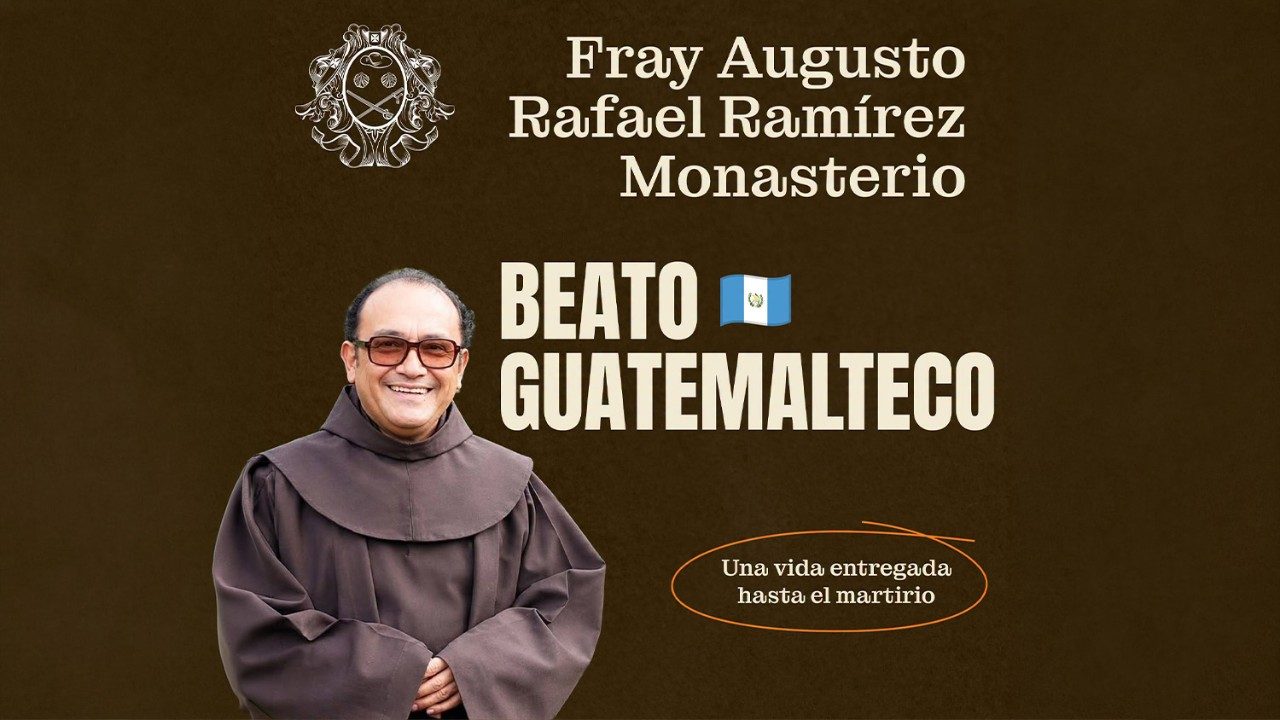
The Catholic Church in Guatemala celebrated the beatification of Fray Augusto Ramírez, a Franciscan priest who suffered martyrdom for defending the sacramental seal and refusing to betray his ministry. The ceremony took place on November 7 in Antigua, Guatemala, on the 43rd anniversary of his death. The rite was presided over by Cardinal José Francisco Robles Ortega on behalf of the Holy Father.
During the homily, the cardinal said that the people of God receive with joy «the beatification of a son of this land. A member of the Franciscan Family. In the year in which the Church celebrates the eighth centenary of the passing of St. Francis into heaven.» He also said: «With this beatification, our Mother Church has granted us the joy of having a new intercessor in heaven from this day forward. May Blessed Fray Augusto Ramírez Monasterio inspire Guatemalan families to live in humility and solidarity, and may he sustain priests throughout the world in daily fidelity to the promises of their ordination!»
Cardinal Robles Ortega highlighted Fray Augusto as «a pastor who preferred faithful silence to betrayal of his ministry. A voice that today represents all those brothers and sisters who, sadly, met the same fate, but who with fidelity and courage gave vigorous testimony of the faith.» He also shared details of the suffering the new beato endured: «Let us look at the official image of Fr. Augusto, which we unveiled today with such emotion and joy: his hands are tucked inside the sleeves of his habit, because a few days earlier he had been kidnapped and tortured, hung from the ceiling by iron handcuffs, leaving his hands purple and burned, so much so that he preferred to cover them when he was asked for a photograph.»
In his homily, the cardinal stressed two significant aspects of the seal of confession and its inviolability based on Fray Augusto’s testimony. First, he said the confessional must be regarded as a «sanctuary of mercy,» and therefore the sacramental seal «is not a mere ecclesiastical privilege or a legal rule […]. It is an absolute requirement that flows directly from the holiness of the sacrament»—that is, pressuring a priest to break it would be «an attack on the most sacred freedom of the human being and on the mercy of the Father himself.» Second, he mentioned «the inviolability of conscience,» an aspect that led those present to recall the words the beato heard on the day of his priestly ordination: «do not be afraid of those who kill the body but cannot kill the soul.» «Defending the sacramental seal meant for him defending the dignity of every person, ensuring that the sinner would always find a safe refuge where he could rebuild his life without fear of losing salvation,» he added.
From the pain he suffered before his death, the suffering he was subjected to for remaining firm in defense of his ministry, and the loss of his life to safeguard his faith, «flow very clear and urgent commitments for all of us, priests of the 21st century,» the cardinal emphasized. «The commitment to absolute confidentiality» was the first responsibility Robles highlighted, reminding priests that «we are called to be zealous guardians of the consciences of our faithful»; and to this duty he added «the commitment to closeness to suffering»: «After exercising his ministry in Spain, Fray Augusto returned to his homeland to devote himself to pastoral work and to the defense of the poorest. Our ministry cannot be detached from the pain of our people. We must be pastors with ‘the smell of the sheep.'»
Context and relevance
The beatification of Fray Augusto Ramírez stands as a call to «not be afraid,» an invitation that this martyr embraced and defended with his life; an exhortation for the people of God to welcome the Word with courage and protect it against any interference that threatens it. «Today we can contemplate the whole life of Fray Augusto as a long journey toward that word he heard on the day of his ordination: ‘Do not be afraid.’ He heard it when he began his ministry. He lived it when he served his people. He sustained it when he was put to the test. And he carried it to its ultimate consequences when he decided to remain faithful to the ministry that God had entrusted to his priesthood,» Cardinal Robles Ortega concluded.
Original source: www.vaticannews.va (published November 7, 2026)