On the day of his liturgical feast, celebrated on October 12, the figure of Saint Carlo Acutis is once again in the spotlight. He died in 2006 at the age of 15 and is remembered as the Church’s first «millennial» saint. His life, far from unfolding in distant or vague settings, took place in concrete places that still exist and can be visited by those who wish to learn more about his story. From London to Milan, by way of Assisi, these spaces saw a young man grow up leading an ordinary life—among family, school, and friends—yet marked by a profound faith.
Carlo was born on May 3, 1991, in London, England, where his parents, Andrea Acutis and Antonia Salzano, were staying for work. He would live there only a few months, however. He was baptized fifteen days after his birth, on May 18, 1991, at the Church of Our Lady of Dolours in Chelsea, London, by the Servants of Mary. His mother, Antonia, would later admit that before her son’s birth she had attended Mass only for her first communion, her confirmation, and her wedding. It was Carlo who, as he grew, brought her back to the faith with his questions and his desire to attend Mass and receive the sacraments.
After returning from England in September 1991, the Acutis family settled in Milan, Italy, where Carlo would live his entire life. There he attended school and catechism, and it was in that city that his faith took root and grew. He grew up in the Magenta neighborhood, in Milan’s historic center, an area full of religious and artistic sites. In that neighborhood stands, among others, Santa Maria delle Grazie, which houses the famous Cenacolo Vinciano, where Leonardo da Vinci’s The Last Supper is preserved. The family apartment is located in this neighborhood, near the Church of Santa Maria Segreta, where his parents still live today.
In his neighborhood, Santa Maria Segreta, on Piazza Tommaseo, was Carlo’s parish. He went to Mass every day, prayed the rosary, and taught catechism to children. A relic of the young saint is kept in the church in his memory, and the parish community center bears his name. On June 16, 1998, at the age of 7, Carlo made his first communion with special permission due to his young age, at the Bernaga monastery in Perego, about 50 km from Milan. This 17th-century monastery housed a community of nuns, the Ambrosian Hermitesses. The Eucharist would hold a central place in Carlo’s life; he described it as his «highway to Heaven»: he attended Mass and adored the Blessed Sacrament every day.
Carlo began primary school at the San Carlo Institute in Milan in September 1997. After three months, he transferred to the Tommaseo Institute of the Marcelline Sisters, closer to his home and located across from his parish. There he completed all his education, from primary through secondary school, until 2005. The nuns remember him as a cheerful student who was attentive to classmates who felt isolated. In September 2005, he entered the classical high school at the Leone XIII Institute, run by the Jesuits. He did not hide his faith and took part in the center’s Christian life. He also put his computer skills at the service of the school and designed the website for the Leone XIII Institute’s volunteer program. Those who knew him recall his spontaneity, his enthusiasm, and the attention he gave to others, especially people in difficulty.
Carlo reached out to homeless people near the Arch of Peace, an emblematic monument in Milan, but also in his neighborhood and at soup kitchens. Rajesh, a native of Mauritius employed in the family’s home, often accompanied him, and together they distributed food and sleeping bags to homeless people. In addition, Carlo spent most of his vacations at the family home in Assisi, in Umbria, in central Italy. Each time he was overjoyed to return to the city of Saint Francis, the Poverello. At the end of his life, stricken by fulminant leukemia, he asked to be buried in that city he loved so much.
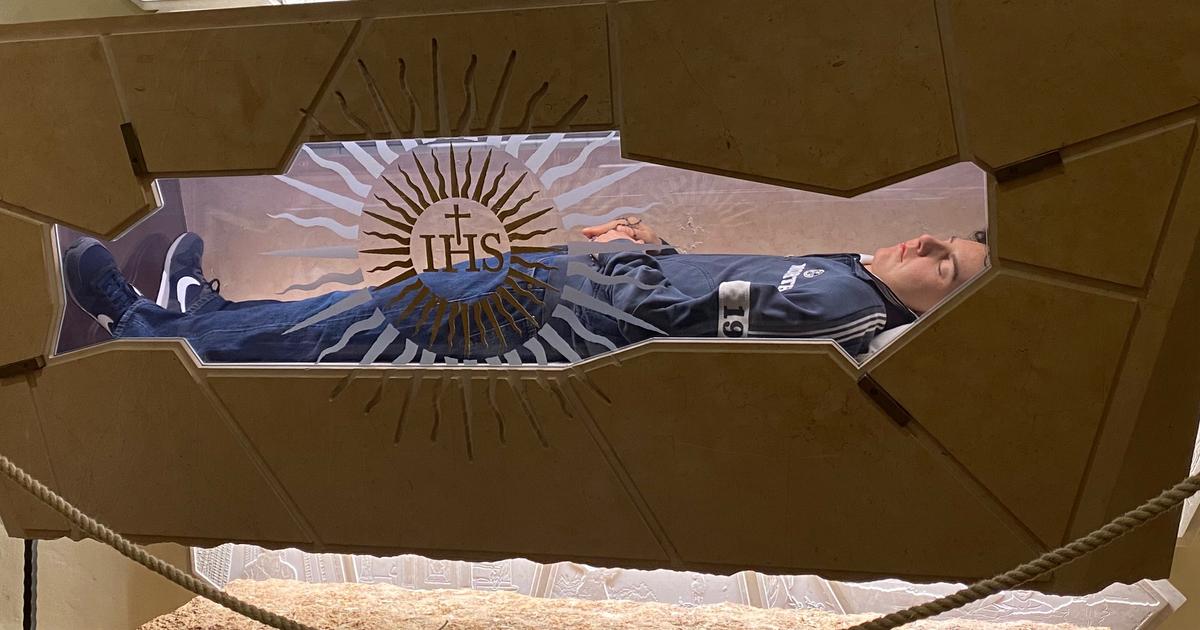
The Sanctuary of the Spogliazione (of the «Stripping») is located in the Church of Santa Maria Maggiore in Assisi, where Carlo’s body was transferred in 2019. There he rests, in view of pilgrims, dressed as he was in life: in jeans, a sweatshirt, and sneakers. Every year, thousands of young people and families go there to pray. The sanctuary received nearly one million visitors in 2024, according to the diocese. Carlo’s beatification was celebrated in Assisi on October 10, 2020. On September 7, 2025, in St. Peter’s Square in Rome, Pope Leo XIV proclaimed Carlo Acutis a saint, together with Pier Giorgio Frassati. The ceremony, initially scheduled for April 27, had been postponed after the death of Pope Francis. It became the first canonization of Leo XIV’s pontificate. Carlo thus becomes the first «millennial» saint in the history of the Church. His liturgical feast is set for October 12, the anniversary of his death, which occurred in 2006 at San Gerardo Hospital in Monza, near Milan.
Context and Relevance
The figure of Carlo Acutis stands out for his closeness to contemporary life. Passionate about computing, he taught himself to program and devoted his free time to compiling the world’s Eucharistic miracles in a virtual exhibition that has since traveled through parishes. Those who knew him remember him as a cheerful young man, attentive to the poorest, who had given Christ the first place in his life. His life unfolded in recognizable settings: school, the neighborhood, the parish, friends. That ordinariness, combined with his deep Eucharistic devotion and his service to others, makes him a model for today’s young people. Devotion to his figure is expressed in pilgrimages to the places where he lived, especially the sanctuary in Assisi, which attracts crowds. His canonization, the first of Leo XIV’s pontificate, underscores the relevance of a saint who knew how to integrate technology and faith, and who continues to inspire through his witness of charity and his love for the Eucharist.
Original source: es.aleteia.org (published on October 10, 2026)