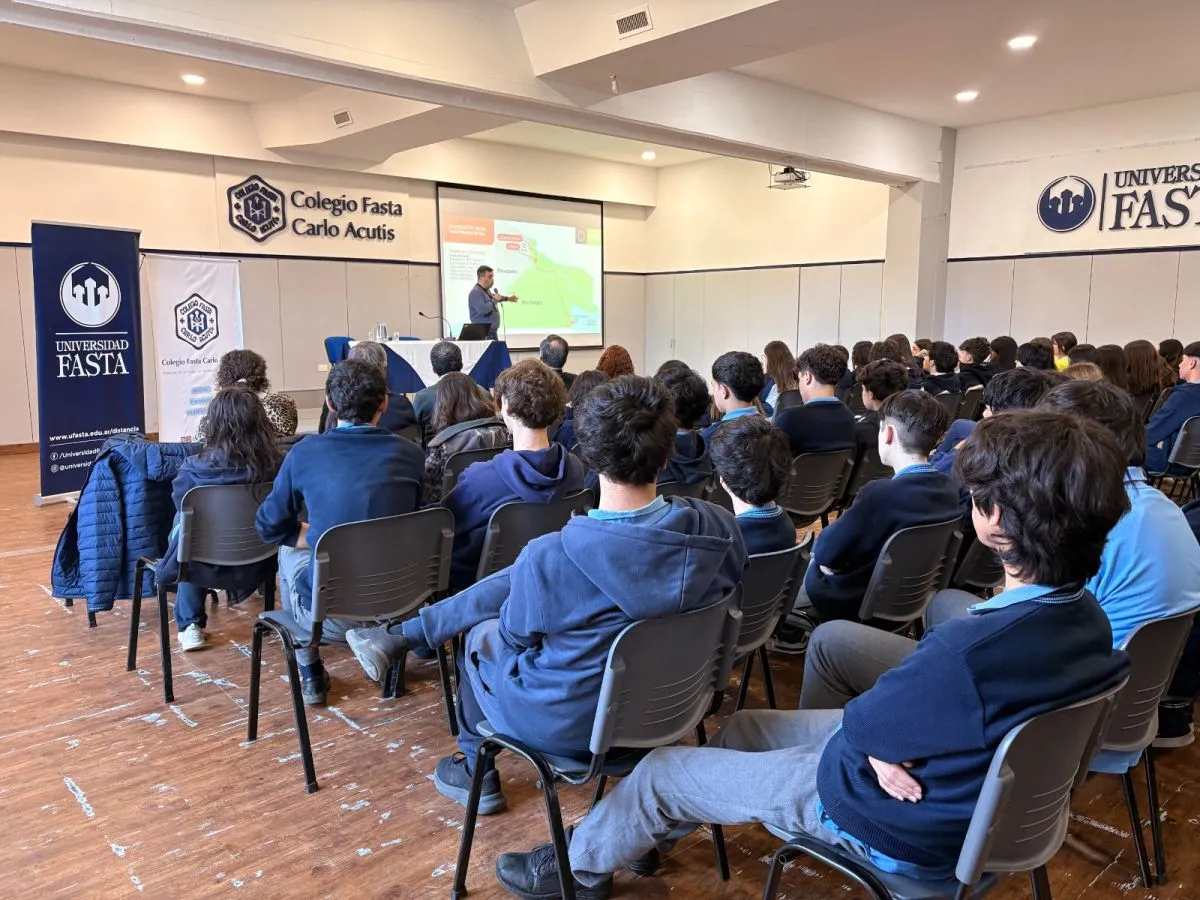
FASTA Carlo Acutis School and FASTA University welcomed legislator Carlos Valeri and Lic. Mario Figueroa, Secretary of Institutional Relations at the Río Negro Provincial Energy Secretariat, who shared with students and representatives of both institutions a day of exchange on energy development, the characteristics of the territory, and the opportunities opening up around the region’s hydrocarbon activity. The event was part of initiatives linking education with the region’s productive and educational environment.
The meeting was especially connected to the Natural Sciences track at the Secondary Level, which covers content related to geological knowledge, the territory, and productive sectors. Within this framework, students were introduced to the development of Vaca Muerta, planned investments, and the growth projections this process may generate at the national, regional, and local levels. The initiative brought young people closer to a productive reality they often know through the news but which takes on another dimension when they can understand its characteristics, its needs, and the concrete possibilities for professional participation.
During the session, projects related to the hydrocarbon basin and the development of energy infrastructure were discussed, along with various aspects of the activity and its impacts on the territory. One of the most significant aspects of the meeting was the exchange and interest shown by the students, who asked questions about waste management, environmental care, employment possibilities, the professional profiles required, and the skills needed to enter the labor market. The students’ interest brought to light a central question for education: how can what they learn at school help them understand and take part in the world around them?
In this sense, the meeting showed that the Natural Sciences track is not only an academic choice but can also be linked to concrete professional and productive fields. It also prompted reflection on the importance of the skills today’s labor market demands, which go beyond technical knowledge to include communication, teamwork, adaptability, problem-solving, and other personal and professional abilities. For FASTA University, the session was also an opportunity to work on the training demands and needs of the productive environment and to identify possible spaces for professional insertion for its graduates. In this way, linking with productive sectors strengthens the circuit between education, profession, and community, reviving a fundamental question about the purpose of the University: what and whom is it educating for?
Context and Relevance
The meeting also highlighted a characteristic of FASTA’s educational approach: the integral formation of the person. Facing a productive world that requires specific knowledge but also human and relational skills—highly valued by the productive fabric—the School and the University can offer a perspective that integrates academic training, job skills, soft skills, and formation in virtues for the common good. The session thus became a learning space that allowed students to learn firsthand about some of the processes transforming the region’s productive matrix and, at the same time, to begin imagining what place they might occupy in them based on their own interests, abilities, and educational paths.
The activity, carried out as part of initiatives linking education with the region’s productive and educational environment, included the participation of students and representatives from both institutions. The presence of legislator Carlos Valeri and Lic. Mario Figueroa, Secretary of Institutional Relations at the Río Negro Provincial Energy Secretariat, enabled a direct exchange on the characteristics of the territory and the opportunities opening up around hydrocarbon activity. This type of meeting strengthens the connection between academic training and the concrete demands of the productive sector, offering young people a more complete view of professional possibilities in the region.
Original source: www.anbariloche.com.ar (published on September 24, 2026)