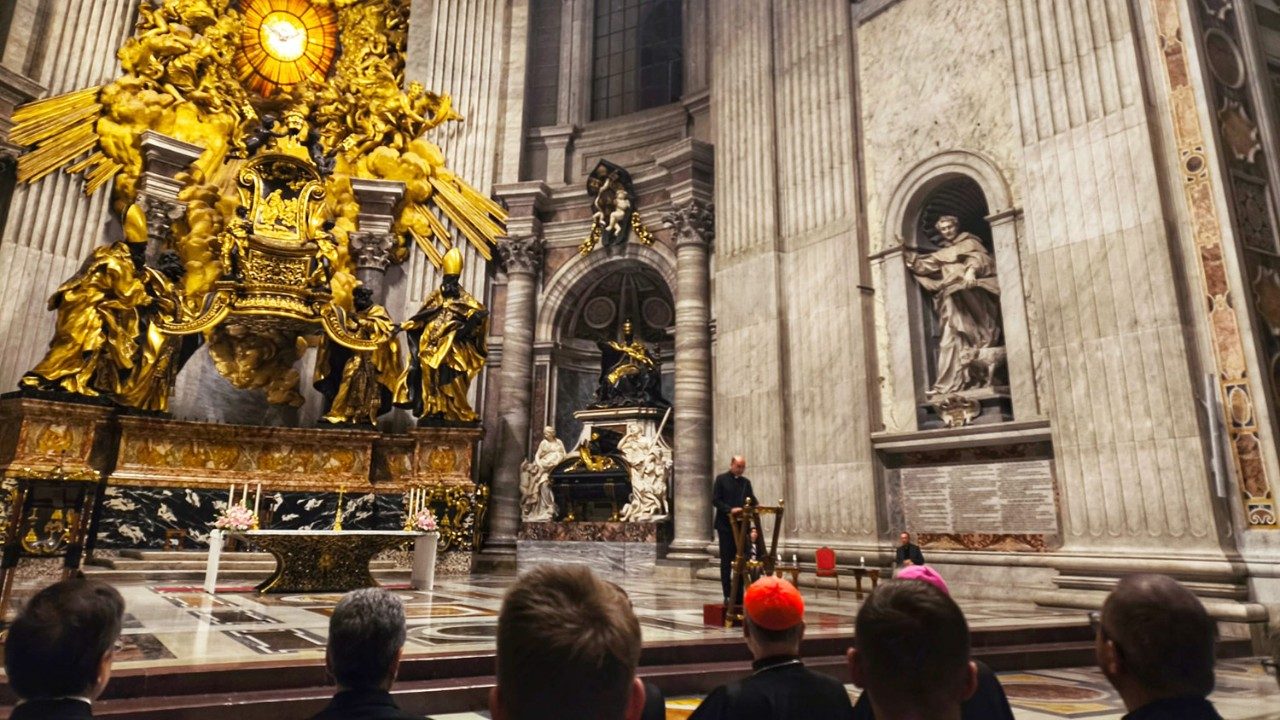
St. Peter’s Basilica remains a space where the memory of the Apostle Peter intertwines with the life of the universal Church and with the faith journey of those who visit it. As part of the fourth centenary of its dedication, the Fabbrica di San Pietro organized a series of meetings to reflect on its spiritual and pastoral significance. On October 13, the third meeting of this series was held, with contributions from Caterina Bruno, professor at the Higher School of Art and Theology in Naples; Fr. Vito Mignozzi, dean of the Theological Faculty of Apulia; and Fr. Andrea Lonardo, director of the Office for Culture of the Diocese of Rome. The day included musical interludes by the Giulia Musical Chapel.
Pilgrimage as a Journey Toward a Destination
Caterina Bruno explored the theological and existential meaning of pilgrimage, relating it to the disorientation of contemporary men and women. She noted that the human condition can be compared to Cain’s wandering, a roaming marked by fear and lack of direction. Christian pilgrimage, by contrast, introduces a destination and an orientation, recalling the significance of St. Peter’s Basilica as the place toward which the path converges. Here, the pilgrim does not simply encounter a monument but faces the testimony of the Apostle Peter, the memory of his faith, and the place traditionally linked to his burial.
Pilgrimage is also an experience that confronts individuals with their own fragility and the need to trust in others. It means recognizing one’s limits and entrusting them to someone, opening oneself to welcome. It is precisely at Peter’s tomb, as Caterina Bruno explained to Vatican media, that one can experience this ‘profound welcome.’ Pilgrimage thus becomes an inner journey, in which the memory of the Apostle leads to rediscovering the meaning of one’s relationship with God. An experience capable of transforming one’s outlook on daily life and relationships with others, opening the possibility of rediscovering a more authentic harmony with oneself and with those around us: ‘Here one can experience a profound reconciliation,’ the professor concluded.
St. Peter, Symbol of Unity for the Churches
The basilica’s universal vocation was the central focus of Fr. Vito Mignozzi’s reflection. The link with the Apostle’s testimony and martyrdom constitutes, according to the dean of the Theological Faculty of Apulia, a fundamental key to understanding the catholicity of the Church. The basilica thus evokes not only the origins of the Christian community but also the responsibility of witness. Its universality is not measured simply by the geographic origin of those who visit it, but by the communion it is called to express. Mignozzi emphasized the link between the Petrine ministry and the unity of the Church, recalling that the successor of Peter is ‘a principle of unity among the Churches.’ A function that finds particular expression in the basilica and evokes the responsibility of safeguarding communion among different ecclesial communities.
This vocation takes on even greater significance in an era marked by conflicts and divisions. St. Peter’s Basilica is, in fact, a place of encounter among people from different countries, languages, and cultures, where an apparent paradox is manifested: peoples living in situations of conflict can find themselves united in celebrating the same faith. ‘In this basilica, peoples who may be in conflict with one another politically and socially gather, but here they somehow recover unity,’ Mignozzi told Vatican media. The liturgy and the life of the ecclesial community thus become a concrete sign of the possibility of overcoming divisions and building the peace that peoples long for. Hence the invitation to recognize in the basilica a vocation that transcends the limits of the community of believers. St. Peter, the priest emphasized, ‘can once again become a sacrament of unity for peoples,’ bearing witness that encounter and communion are possible even in a world marked by tensions.
Beauty as a Language to Address Contemporary Men and Women
Fr. Andrea Lonardo explored the pastoral vocation of the Petrine site, focusing on the role of artistic beauty in awakening wonder and capturing the attention of visitors, even in a context marked by the rhythms of mass tourism. However, the vastness of the spaces can make it difficult to create occasions for authentic recollection. In his talk, Lonardo recalled the challenge of reconciling the basilica’s monumental dimensions with the spiritual dimension of the place, noting that it is ‘such a large place that one cannot pray, but one can do culture well.’ A reflection that places at the center a concrete pastoral question: how can a visit to the basilica be transformed into an occasion for knowledge and, for those who wish, an encounter with faith?
In the interview granted to Vatican media, the priest evoked the experience of St. Philip Neri, who proposed pilgrimage to the Seven Churches of Rome as an occasion for spiritual growth. Visiting these places means, in fact, confronting the history of the Church and the faith of those who preceded current generations. The central idea is that visiting the basilica means not only admiring its beauty but coming into contact with a history of faith that comes from afar and continues to speak to believers today.
The pastoral responsibility of St. Peter’s also consists in finding concrete ways to accompany people beyond mere admiration of the monument. In his talk, Lonardo referred in particular to Bernini’s baldachin, an example of how art can become a form of visual catechesis. Its monumentality goes beyond the image of a simple processional baldachin, made of wood or fabric, to become a sign that directs the gaze toward the heart of the basilica. ‘This enormous structure, which is the height of a five- or seven-story building, when you see it gives you the idea that there is the Eucharist, there is the Mass, there is the tomb of Peter,’ he explained. The memory of the Apostle, the liturgy, and the symbols of Christian tradition offer occasions to rediscover the meaning of faith and the value of reconciliation. The pastoral challenge, therefore, consists in making the artistic heritage accessible and capable of speaking to people, transforming beauty into an instrument of welcome and evangelization, at the service of the basilica’s universal mission.
Context and Relevance
The fourth centenary of the Dedication invites us to rediscover St. Peter’s Basilica not only as a monument preserving the memory of the past but as a living space, in which the history of the Church continues to dialogue with the questions of contemporary men and women. The reflections that emerged during the meeting highlighted a mission that unites the safeguarding of tradition with the challenges of the present. Pilgrimage to the Apostle’s tomb, communion among the Churches, and pastoral welcome converge in a single vocation: to make the Basilica a place where beauty opens the path to spiritual seeking, memory is translated into witness, and encounter among people and cultures evokes the universal dimension of the Church, called to proclaim Christ and promote communion among peoples.
Original source: www.vaticannews.va (published October 15, 2026)