The Context of a Revelation
In February 1858, Lourdes was a small town of about four thousand inhabitants in the French Pyrenees. There lived Marie-Bernarde Soubirous, known as Bernadette, a fourteen-year-old girl from a humble and illiterate family. On the 11th of that month, while gathering firewood with her sister and a friend at the Massabielle Grotto, on the banks of the Gave River, Bernadette experienced an event that would change her life and the religious history of the place.
The Visions and the Message
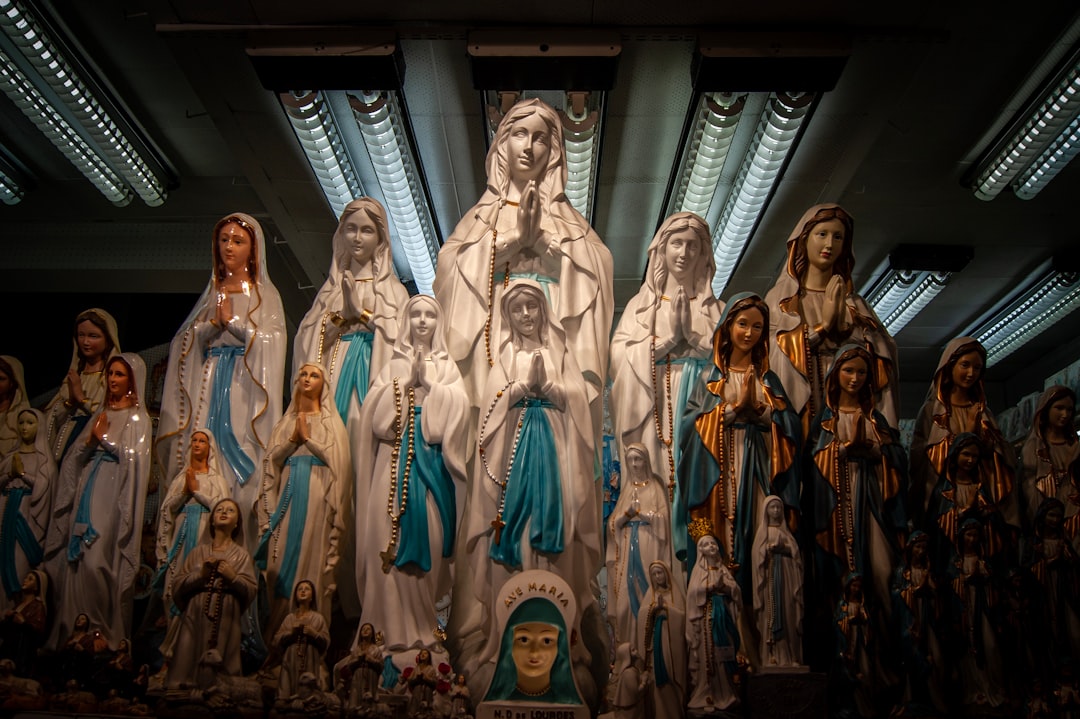
According to her testimony, while crossing a stream she heard a sound like a gust of wind. Raising her eyes towards the grotto, she saw a female figure dressed in white, with a blue belt and a golden rose on each foot. The young girl made the sign of the cross and prayed the rosary before the apparition vanished. This was the first of eighteen encounters that lasted until July 16 of the same year. During the successive visions, the figure, described as a young lady, conveyed messages of penance and prayer.
The Spring and Initial Skepticism
On February 25, during the eighth apparition, before more than a hundred onlookers, Bernadette dug with her hands in the ground of the grotto. From there sprang a water source that began to flow. Although subsequent analyses found no extraordinary medicinal properties in its chemical composition, these waters were soon attributed with healing effects, attracting pilgrims who reported cures considered inexplicable. The initial skepticism of the authorities and part of the population gradually gave way to growing devotion.
The Identification and Ecclesiastical Recognition
The climax occurred on March 25, 1858. In the sixteenth apparition, the figure revealed her identity with the words «Que soy era Immaculada Councepciou» («I am the Immaculate Conception»). This declaration, foreign to the girl’s vocabulary, had great theological resonance, as the dogma of the Immaculate Conception had been proclaimed by Pope Pius IX only four years earlier. After exhaustive interrogations by civil and ecclesiastical authorities, where Bernadette maintained a consistent version, the Bishop of Tarbes, Mons. Laurence, declared the authenticity of the apparitions in 1862. That same year, the Pope authorized the cult of the Virgin Mary in Lourdes.
Bernadette’s Later Life and the Expansion of the Sanctuary
Bernadette entered the congregation of the Sisters of Charity of Nevers in 1866, where she lived until her death at the age of 35 on April 16, 1879, affected by health problems. She was canonized in 1933 by Pope Pius XI. Meanwhile, in Lourdes, a sanctuary was built that transformed the village into a world pilgrimage center. The consecration of the basilica in 1876 attracted 100,000 people. The numbers grew to six million pilgrims in the centenary year of 1958, remaining at around five million annually today. The place has established itself as one of the epicenters of Catholic spirituality and Marian devotion globally.
Original source: www.larazon.es (published on February 11, 2026)
Photo: Jean-Baptiste D. on Unsplash