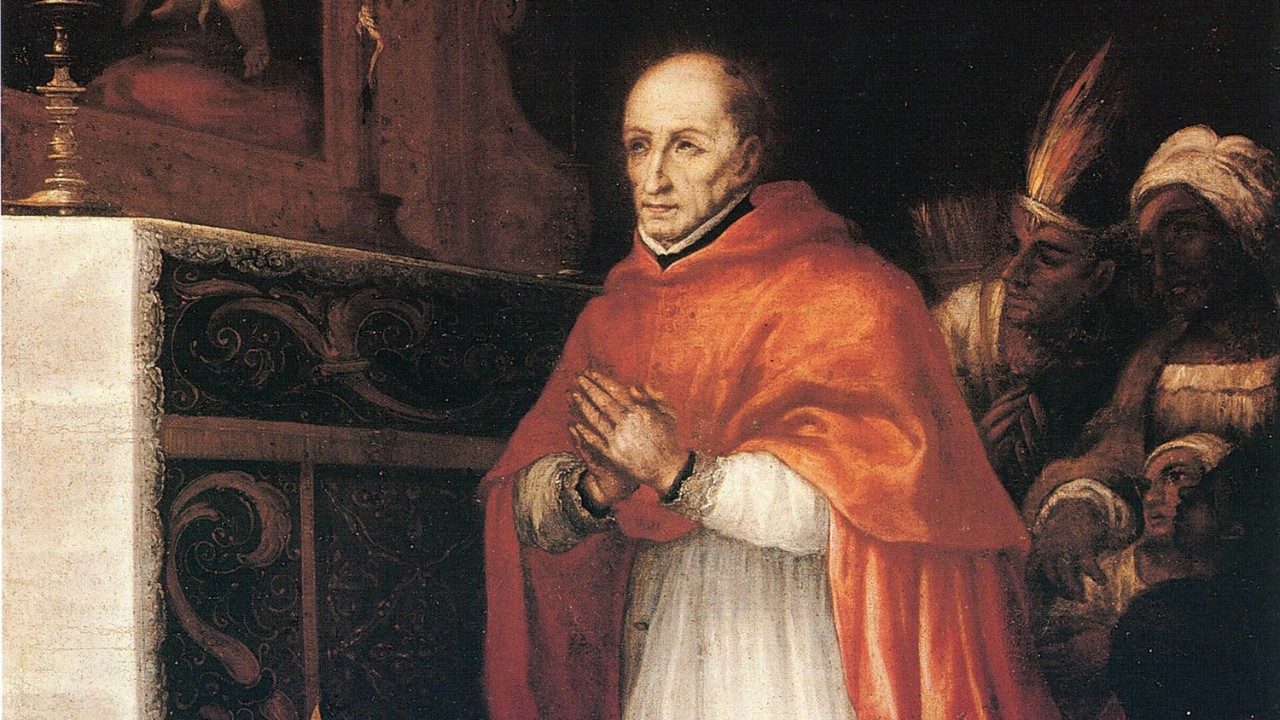
On the afternoon of November 14, Pope Leo XIV will hold a prayer meeting with the Catholic community at the sanctuary dedicated to Santo Toribio de Mogrovejo in Zaña, on the occasion of the closing of the jubilee year convoked for the third centenary of the saint’s canonization, which occurred in 1726. The visit is part of the Pope’s apostolic journey to Peru and highlights the figure of an archbishop who, in the 16th century, left a decisive mark on the Peruvian Church.
Toribio de Mogrovejo, a descendant of a noble Spanish family, a brilliant jurist and expert in canon law, was proposed by King Philip II of Spain as archbishop of Lima, then called the City of the Kings, capital of the viceroyalty of Peru. He tried in vain to reject the appointment. In a short time he received holy orders and was appointed by Pope Gregory XIII as archbishop of the City of the Kings. In 1581 he set out for that mission land, which would change his life forever.
From there began an adventure of love for Jesus Christ that led him to travel thousands of kilometers through his archdiocese, in territories that were often difficult to access. Tirelessly, on foot or on the back of a donkey, driven solely by the zeal to proclaim the love of God to thousands of people, many of whom had not yet known Jesus Christ. Toribio did not disembark at El Callao, as would have been normal, but at Paita, some thousand kilometers north of the capital, Lima, and then reached it on donkeyback, thus meeting the populations he was to guide spiritually. Father Fidel Zavaleta, episcopal vicar for the clergy of Lima, describes that gesture as “an embrace of closeness to the people.”
His work as a great reformer led to the first true organization of the Peruvian Church. A fundamental aspect of his labor was the convocation of the Third Council of Lima in 1582, which established the obligation for all priests to learn the local languages in order to confess and preach in a way understandable to the populations. He is also credited with the publication of the trilingual Catechism—in Spanish, Quechua, and Aymara—and the founding of the first seminary in Latin America. Santo Toribio sought to reach the deepest part of the heart of the indigenous population. “He wanted to proclaim the Gospel to them with love, inculturating himself in their reality, with great charity and mercy, to teach them the path of salvation. He also learned the Quechua and Aymara languages,” explains Father Zavaleta.
Santo Toribio did not remain enclosed in the splendor of the viceroyalty, but traveled tirelessly through his archdiocese, some 450,000 square kilometers, to proclaim the Gospel. It is estimated that, of the approximately 25 years he was archbishop in Peru, “he spent only 8 years in the capital, while the other 17 he devoted to long journeys evangelizing and defending the dignity of the local populations,” says Father Zavaleta. The geography of Peru is very varied: it ranges from desert coasts to the high mountains of the Andes and the jungle. “The archdiocese of Lima, at that time, encompassed these three areas, so much so that its territory then corresponds today to 17 ecclesiastical jurisdictions. Where today there are 17 bishops, at that time there was only him. He went where there was a need to manifest God’s mercy, especially to the poorest and most defenseless,” continues the priest. “It is estimated that Saint Toribio traveled some 40,000 kilometers on his pastoral visits because, for him, no one was small. There was no small town, no person was small: for him, all were children of God.” His concern “was that everyone know the love of God.”
“He brought the Lord’s mercy to all, but he also promoted justice and human rights. Toribio did not permit any kind of abuse against the indigenous people of Peru,” whom he “loved intensely, as a father loves his children.” “He not only preached with words but also with deeds.” His main commitment was “to show the world the love of God, to show who Jesus is.” Santo Toribio administered the sacraments to very many people, such as Confirmation to the future first saint of the Americas, Saint Rose of Lima, and also to the future saints Martin de Porres and Francisco Solano.
Context and relevance
The jubilee year coincides with the third centenary of the canonization of Santo Toribio in 1726. It was precisely in Zaña that the archbishop died, on Holy Thursday, March 23, 1606. “There is currently the tomb where Saint Toribio remained buried for a year before his body was transferred to Lima. It is a place of pilgrimage and Robert Prevost used to go to pray in Zaña,” which belongs to the diocese of Chiclayo, of which he was bishop, explains Father Zavaleta. “It is a sacred place for us. We have made pilgrimages, we have prayed before the tomb of Saint Toribio.” “The Pope was greatly inspired by Santo Toribio, a saint who touched the most sensitive chords of Leo’s heart.” Finally, he recalls that the Peruvian people are enthusiastic about the arrival of Leo XIV. “For us it is receiving a father who returns home again, this time as Pope,” he affirms, expressing the joy of Peruvians. Precisely in the Letter on the occasion of the third centenary of the canonization of Santo Toribio, referring to his episcopal ministry in Peru, the Pope highlights having known “up close the faith of a people from whom I received much and understood better what it means to be a pastor. That experience brought me particularly close to Saint Toribio, who also came from afar to a land that he ended up making his own through pastoral charity.”
Original source: www.vaticannews.va (published on November 12, 2026)