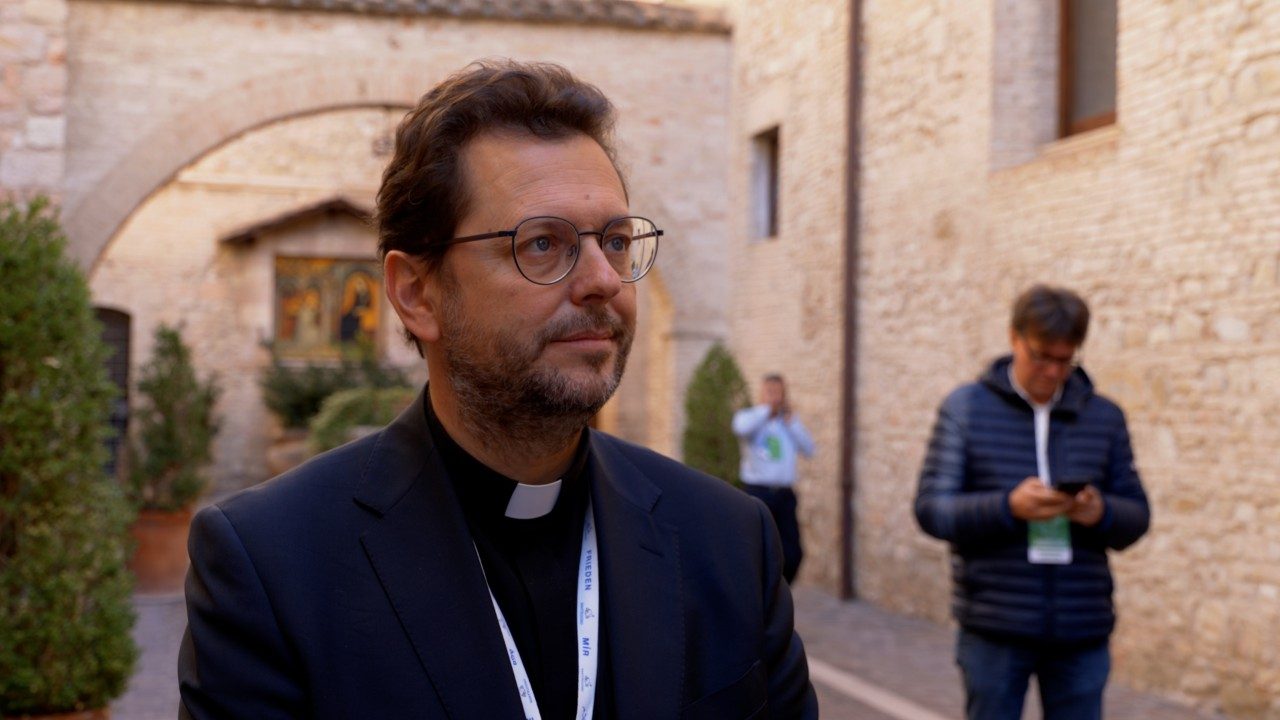
Cardinal Giorgio Marengo, apostolic prefect of Ulaanbaatar, took part in the International Meeting for Peace «Disarmed and Disarming Peace,» promoted by the Community of Sant’Egidio in Assisi, forty years after the historic day of prayer convened by John Paul II in 1986. Speaking to Vatican media, Marengo also referred to the audience on Monday, October 26, during which Pope Leo XIV received the cardinal together with the abbot of the Gandan Buddhist monastery, one of Mongolia’s principal spiritual centers.
The cardinal described that meeting as «a sign of great esteem and friendship» and explained that its main purpose was to confirm and strengthen «this fruitful relationship that already exists between the Catholic tradition, which in Mongolia represents an absolute minority, and the Buddhist world, which is the majority.» According to Marengo, it was «a meeting between religious leaders who wanted to send a clear message: dialogue, fraternity and the promotion of peace are possible.»
The cardinal stressed that dialogue must be lived «as friendship, as understanding, starting naturally from respect, study and mutual understanding.» In his view, this «shows societies that religious traditions are allies in building the common good, not antagonists.» He added that this message is important «especially for societies that may have experienced situations of isolation from the rest of the world.» When that commitment is translated into initiatives of dialogue, encounter and the promotion of shared values, it becomes clear that religious traditions are promoters of the common good and peace, he said.
Marengo took part in the panel «1986-2026: The Relevance of the Spirit of Assisi,» together with Muhammad Abdul Khabir Azad, Grand Imam of the Badshahi Mosque in Lahore, Pakistan; Jaron Engelmayer, Chief Rabbi of Vienna, Austria; and Jean-Dominique Durand, president of the French Association of Jewish-Christian Friendship. In that context, the cardinal emphasized that the 1986 meeting represented «a fundamental step on the path of interreligious dialogue» also in Mongolia, a country undergoing profound social transformations, where «the massive and often uncontrolled incursion of digital technology and new forms of sociability» risks causing a rapid loss of relational and spiritual reference points.
According to Marengo, interreligious dialogue helps «keep one’s gaze lifted up and curb the phenomena of isolation, loneliness and disorientation among many young people.» The cardinal also recalled Pope Francis’s 2023 trip and evoked the centrality of the ger, the traditional Mongolian tent that invites an opening upward, through which the light enters, as a testimony to the spiritual dimension of existence. He concluded by describing the Mongolian sky with a saying from popular wisdom: «The clouds pass, the sky remains,» an expression that, he explained, recalls that «the vertical dimension of life is in fact more fundamental than the horizontal one.» «In Mongolia, as you walk, you have the perception that the sky is more real than the earth. And this is also a message that every religion, every religious tradition, offers to the world,» he said.
Context and relevance
The Assisi International Meeting for Peace, promoted by the Community of Sant’Egidio, commemorates the day of prayer convened by John Paul II in 1986. In this edition, Cardinal Marengo stressed that the «Spirit of Assisi,» «even without making noise, is transforming the lives of so many people» through initiatives that often do not appear in newspapers but continue to influence positively the decisions of men and women in various parts of the world, even in an international context marked by «great confusion and global tensions.»
The experience of the Catholic Church in Mongolia, where it is an absolute minority facing a Buddhist majority, serves as an example of how religious traditions can be allies in building the common good. Cardinal Marengo insisted that this commitment is measured above all in everyday gestures, relationships and experiences of fraternity that often go unnoticed, and that constitute the deepest legacy of that 1986 meeting.
Original source: www.vaticannews.va (published October 27, 2026)